
Most B2B brand strategies in 2026 will fail for the same reason: they sound exactly like every competitor's.
Your buyers have already tuned you out. Not because your product is bad, not because your messaging is wrong, but because everyone else is sending the same emails, running the same ads, and showing up at the same events with the same pitch. The noise is everywhere, and it all sounds the same.
So what does it actually take to cut through? Not just to get a click, but to be the brand someone genuinely remembers, talks about, and chooses when the moment comes?
We dug into what is actually working in B2B right now, from the channels generating real pipeline to the moments that create lasting impressions. Here are eight strategies your team can act on.
1. Build a point of view that takes a genuine stand
The safest content in B2B is also the most forgettable. Thought leadership that says "it depends" on every question, validates every perspective, and never takes a real position, blends into the background the moment it gets published.
The brands that stick are the ones with something specific to say. Not just what they sell, but what they believe, what they think the market is getting wrong, and what they are willing to say publicly that others won't.
The data backs this up. According to Edelman and LinkedIn's B2B Thought Leadership Impact Report, 73% of decision-makers find thought leadership more trustworthy than traditional marketing materials. And yet only 26% of B2B brands are highly rated for the quality of their thought leadership, which means the gap between average and excellent is enormous.
The brands winning this space are the ones building a consistent, identifiable point of view across every channel, not just a content calendar. That means taking a position in industry debates, sharing contrarian perspectives backed by real evidence, and giving your internal experts a platform to say something interesting, not just something safe.
2. Turn your executives into visible thought leaders on LinkedIn
LinkedIn has become the primary arena for B2B brand building, but the brands getting the most out of it are not the ones posting from company pages. They are the ones activating their people.
Research shows that 83% of B2B marketers say LinkedIn is their primary distribution channel, and the organic reach of personal profiles consistently outperforms branded page content. One data experiment comparing LinkedIn Thought Leader Ads (ads running from personal profiles rather than company pages) against standard image ads found that TLAs generated 83% of all landing page clicks at just 6% of the total budget spend.
The principle extends beyond paid campaigns. When a VP of Marketing or a Chief Revenue Officer shares a genuine perspective, real data, or a behind-the-scenes story, it earns trust in a way that a company post almost never can. Buyers follow people, not logos.
The most effective approach is to pick two or three executives who genuinely have something to say, help them build a consistent posting rhythm, and make it as frictionless as possible. That means ghost-writing drafts, scheduling posts, and giving them a clear set of topics to own. The upside is compounding. Each comment, share, and reaction extends reach beyond the paid audience at zero additional cost.
3. Use corporate gifting and swag to create moments that stick
Picture this. Your team has been working on an enterprise account for three months. Email open rates have flatlined, the LinkedIn requests are stale, and the VP isn't moving. An SDR pulls intent signals on the account, sees the company just announced a strategic initiative your product directly supports, and triggers a relevant gift through Reachdesk timed to a specific business moment, attributed to a specific account, and tracked through to the meeting it earns. Two days later, the VP responds.
That is the difference between spray-and-pray outreach and strategic gifting. Done well, it creates a genuine human moment inside what is often an entirely transactional process. And the numbers back it up. According to Reachdesk’s State of Corporate Gifting and Swag 2025 Report, gifting campaigns achieve open rates of 85% versus 39% for traditional emails, click-through rates of 58% versus 3.25%, and conversion rates of 56% versus around 3%. Those are not incremental improvements. They are a different category of result entirely.
The mechanics matter though. Generic mass gifting delivers generic results. Targeted, relevant, well-timed gifting tells a very different story. Pair a thoughtful gift with content that speaks directly to the recipient's role and current challenges, follow up within 24 to 48 hours, and connect the experience to a real business conversation. SentinelOne did exactly this with Reachdesk, generating $1.1 million in pipeline from direct mail with a 38.7x ROI and a 25% close rate.
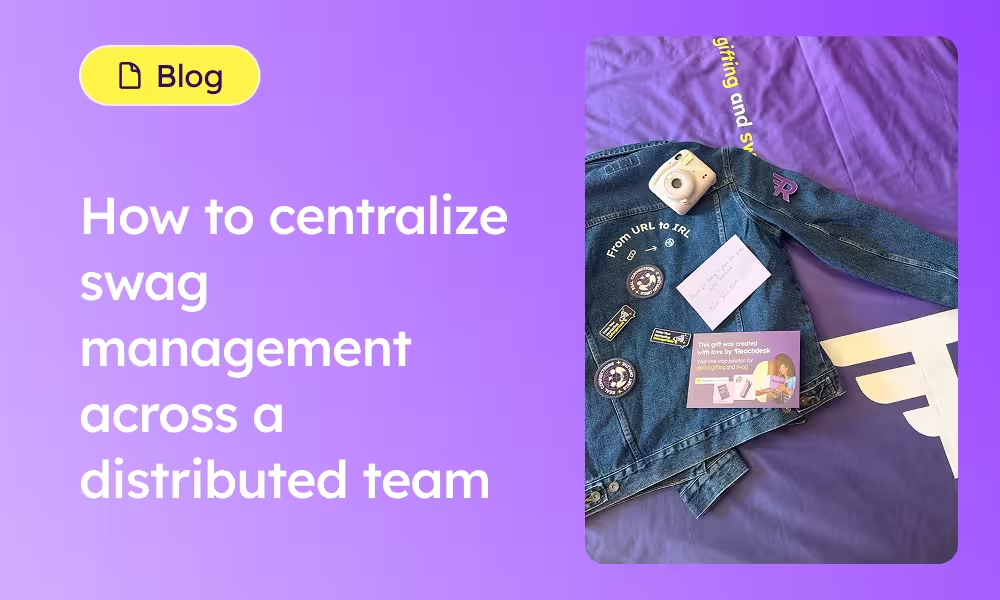
Platforms like Reachdesk make this scalable, with thousands of curated gift options, global logistics, and integrations with Salesforce, HubSpot, and Gainsight so every gifting touchpoint ties directly back to pipeline. Swag plays a role here too. Branded merchandise that actually gets used keeps your brand visible long after the initial touch.
The key is always the same: be specific, be timely, and always follow up.
4. Invest in dark social and private communities
Gartner research shows that B2B buyers now complete 70% to 80% of their purchase journey before ever engaging with a sales rep. And much of that journey happens in channels your analytics stack cannot see: private Slack groups, WhatsApp threads, LinkedIn DMs, and niche online forums where peers share recommendations and flag vendors they trust.
This is what marketers call dark social, and it is where a significant share of real buying decisions get made.
Word of mouth is estimated to account for 20 to 50% of all purchasing decisions, but most of those conversations are invisible to the brands being discussed. You cannot force your way into a private Slack channel. But you can create content so genuinely useful that people forward it. You can show up authentically in the communities where your buyers actually spend time, not to sell, but to contribute. You can build the kind of reputation that makes someone mention your brand when a colleague asks for a recommendation.
The practical move is to identify two or three communities where your ideal customers are active, whether that is a Slack group, a LinkedIn community, a Reddit subreddit, or an industry Discord, and show up there as a real participant. Share useful frameworks. Answer questions honestly. Reference your product only when it is genuinely relevant. Over time, that presence compounds into brand awareness that no ad budget can replicate.
5. Create experiences worth talking about at events
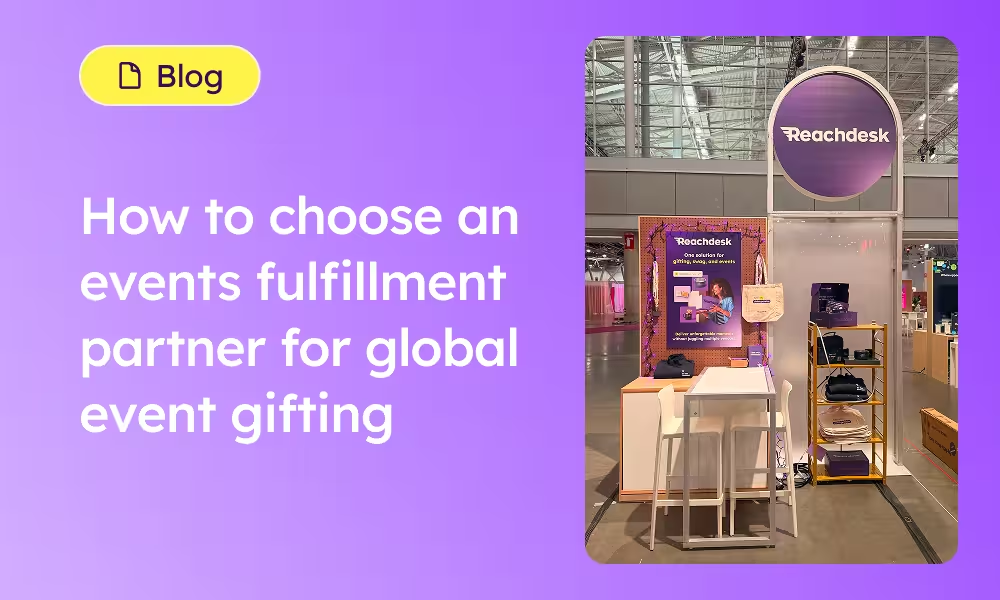
In-person events are considered critical by 87% of B2B marketers, and 71% of attendees say in-person B2B conferences are the most effective way to learn about new products or services. But most brands show up to events with the same booth setup, the same branded pens, and the same "swing by for a demo" energy.
The brands that get remembered are the ones that create something worth talking about.
That could mean hosting a curated dinner for 15 of the most relevant prospects instead of sponsoring a generic happy hour. It could mean running a hands-on workshop with real takeaways rather than a product pitch disguised as a panel. It could mean using gifting strategically before the event even starts, sending targeted gifts to pre-book meetings before anyone lands at the venue, so your schedule is already full when the doors open.
The follow-up is where most event ROI gets lost. Research suggests only about 18% of trade show leads ever receive serious follow-up, which means the vast majority of money spent on events produces nothing. The teams winning at events treat the experience as the beginning of a conversation, not the conclusion of one.
6. Launch a podcast that targets your buyers, not everyone
Podcasting has matured significantly as a B2B channel. 62% of B2B buyers now listen to podcasts, and listeners are 2.7x more likely to view a brand as trustworthy when that brand produces educational audio content consistently.
But the brands getting real pipeline from podcasting are not chasing large audiences. They are being deliberate about who they invite on as guests.
The account-based podcast model is the clearest example. Instead of building a show for the masses, you build a show specifically designed to create conversations with your ideal customers. You invite decision-makers from your target accounts as guests. You give them a platform to share their expertise and build their own profile. And by the time you finish recording, you have already built a genuine relationship, not a cold prospect.
One enterprise software company that implemented this approach across 48 executive guests from target accounts saw a 48% conversion rate of guests to pipeline opportunities and $4.2 million in closed revenue within 18 months. The average deal size was 3x larger than deals sourced through other channels.
The show does not need to be a production behemoth. It needs to be useful, consistent, and aimed precisely at the people you want to build relationships with.
7. Operationalize personalization with intent data
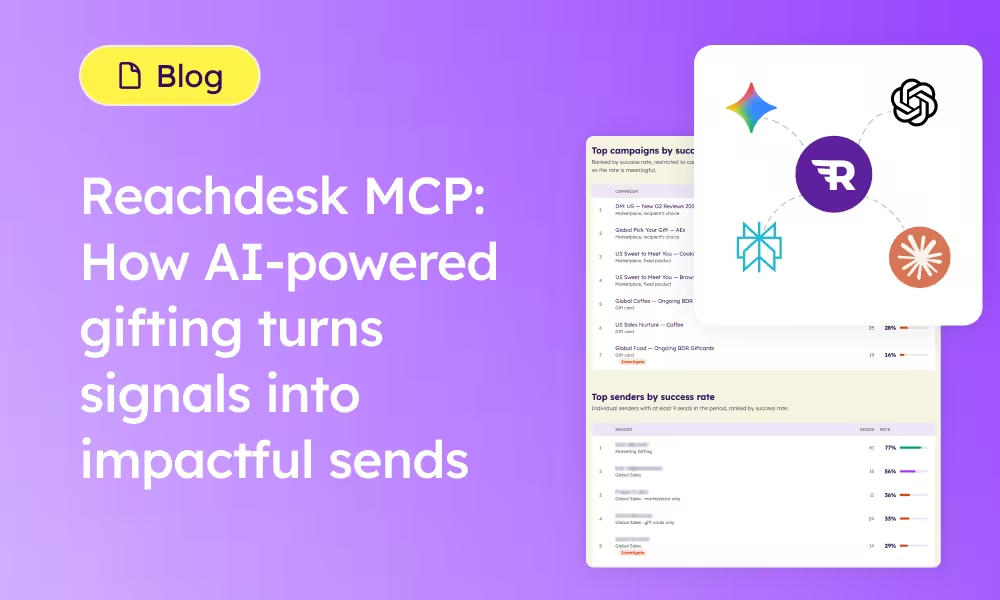
Personalization in B2B has moved well beyond adding a first name to an email subject line. The teams generating real results are using intent data, behavioral signals, job change triggers, hiring patterns, funding announcements, and technology adoption signals, to identify when a prospect is actually in-market and reach them with something relevant at that specific moment.
96% of respondents in HubSpot's 2025 State of Marketing report said that personalized experiences increased their sales. The gap between a generic outreach sequence and one triggered by a real buying signal is the difference between noise and a relevant conversation.
Practical ways to operationalize this include tracking job changes among your ideal customer profiles, because new decision-makers in a role are far more likely to evaluate new vendors in their first six months. It also means monitoring when target accounts post jobs for roles that signal a strategic initiative you can support, or when they raise funding that suggests expansion is on the horizon. Each of these triggers is an opening to reach out with something that feels timely and relevant rather than cold.
Pair intent signals with a genuine offer of value or a personalized gift, not a product pitch, and you create the conditions for a real conversation.
8. Build content for AI search, not just Google
The way B2B buyers discover brands is changing faster than most marketing teams are adapting to. Buyers are increasingly starting their research in AI tools like ChatGPT, Perplexity, and Google's AI-generated summaries, rather than typing keywords and clicking through to results. According to bvik's Trendbarometer 2026, 86% of marketers see Generative Engine Optimization (GEO) as a must-have for content and website strategy in the next two years.
The implication for B2B content teams is significant. Content that ranks well in traditional search works by targeting keywords and building backlinks. Content that gets cited by AI tools works by being clear, authoritative, structured, and genuinely useful when someone asks a specific question.
That means writing content that directly answers the questions your buyers are actually asking, not content that tries to rank for every possible variation of a keyword. It means using original research and proprietary data, because AI systems are more likely to surface sources that provide unique, attributable insight. And it means being consistent and credible enough that when a buyer asks an AI "which platforms are best for B2B gifting?" or "what is the best way to run an ABM campaign?", your brand is part of the answer.
The brands that treat AI discoverability as a first-class priority now will have a meaningful advantage over the ones that figure it out two years from now.
Frequently asked questions about B2B brand strategy
1. What is the most effective B2B brand strategy for 2026?
There isn't one; there are several that compound. The pattern across teams seeing real pipeline lift is the same: a clear point of view, executive presence on LinkedIn, strategic gifting tied to buyer signals, and content built for AI search alongside Google.
2. How is B2B brand building changing with AI search?
A: Buyers are starting research in ChatGPT, Perplexity, and AI Overviews before they ever see a SERP. That shifts content priorities toward clarity, structured answers, and proprietary data that AI tools can cite.
3. What's the difference between corporate gifting and strategic gifting in B2B?
A: Mass-mailed swag is corporate gifting. Strategic gifting is triggered by intent signals, tied to a specific buyer's role and moment, and integrated into the revenue stack, which is why response rates and pipeline impact look fundamentally different.
It’s time to build a memorable B2B brand in 2026
Every one of these strategies comes back to the same idea. Volume without relevance is just noise, and noise is the one thing every B2B buyer is already overexposed to.
The brands that are genuinely hard to forget in 2026 are the ones showing up with a real point of view, in the right channels, with the right message, at the right moment. Sometimes that looks like a podcast conversation that turns a guest into a customer. Sometimes it looks like a well-timed gift that arrives exactly when a deal needed a nudge. Sometimes it looks like a community comment that earns a DM asking for a call.
The tactics differ. The principle is the same. Be specific, be timely, be genuinely useful, and make it impossible for the right people to forget you.
Want to see how strategic gifting fits into your B2B brand strategy?
Book a demo with Reachdesk and see how teams are using personalized gifting to create pipeline, accelerate deals, and build the kind of relationships that actually last.