
Corporate gifting builds prospect relationships when it is timed to intent signals, personalized to the individual, and connected to a measurable follow-up sequence. Used this way, it creates a physical touchpoint that cuts through digital noise, opens conversations, and generates pipeline. This guide covers five areas: how to personalize corporate gifting at scale, how to use CRM data to identify the right moments, how to measure ROI, how to align sales and marketing, and how to choose the right gifting play for each stage of the funnel.
Why physical outreach gets responses when email doesn't
Physical outreach works when digital stalls because it creates a moment a prospect actually remembers. Cold email reply rates have fallen to 3.43% in 2026, down from 8.5% in 2019 (Reachoutly, 2026), and 73% of B2B buyers now actively avoid suppliers sending irrelevant outreach (Gertner, 2025). A well-timed gift does something no email can: it requires a real decision from the recipient, references something specific, sits on their desk to remind them of your brand, and creates a natural reason to follow up with context rather than another cold pitch.
AI tools have made personalized-looking emails cheap and fast to produce, which means buyers are receiving more of them than ever and have become very good at recognizing them for what they are. Physical gifting is not a replacement for digital channels. It is the connective tissue between them, allowing you to create meaningful human moments in your buyers’ journey.
Prospect gifting best practices: 5 ways to increase pipeline and revenue
Prospect gifting works best when it is strategic, personalized, and tied to measurable business outcomes. The most successful B2B teams don't use gifts as random gestures; they use them to create meaningful buying experiences, re-engage stalled opportunities, improve meeting conversion rates, and strengthen customer relationships throughout the funnel.
To generate real ROI, gifting must be relevant to the recipient, triggered by data-driven insights, aligned across sales, marketing, and customer success, and measured against pipeline impact. When combined with CRM data, intent signals, and automation, prospect gifting becomes a scalable revenue-generating channel rather than a one-off tactic.
In this section, we'll explore five prospect gifting best practices that help revenue teams create more meaningful buyer interactions, accelerate deals, and prove the impact of gifting on pipeline and revenue.
1. How to personalize prospect gifts at scale

Effective prospect gifting is built on relevance, not budget. A gift that references something specific about the recipient; a conversation topic, their industry, a trigger event in their account; consistently outperforms generic catalogue items, regardless of price. At scale, relevance requires using CRM data, intent signals, and recipient-choice options to make every send feel considered. Inserting a name or company into a template is personalization. Connecting a gift to what a prospect actually cares about is relevance.
As Peter Mollins, VP Marketing at Nooks, put it on Reachdesk’s The Pattern Break 2026 webinar: "Personalization and relevance are not the same thing. Adding a token that says you went to Stanford is not relevant to someone with 10 competing priorities this morning."
What genuinely personalized prospect gifting looks like in practice:
- A gift connected to something the prospect mentioned in a previous conversation
- A curated selection based on their role, industry, or use case rather than a generic catalogue
- Timing that reflects where they are in their buying journey, not your campaign calendar
- A handwritten note that references something specific rather than a template
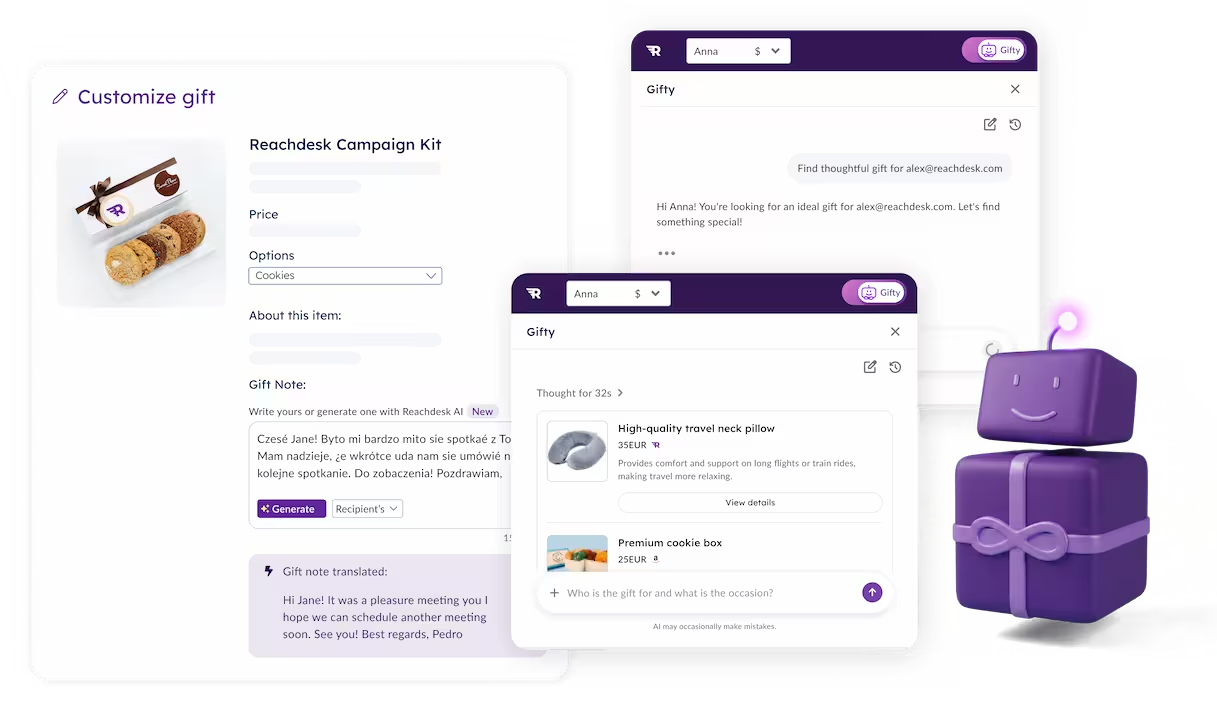
At scale, this requires the right infrastructure. Global gifting platforms like Reachdesk, lets teams build personalized gift experiences with AI-assisted recommendations, multilingual notes, and recipient-choice options, so every send feels considered even when you are running hundreds of them simultaneously.
2. Using CRM data to identify the right moments
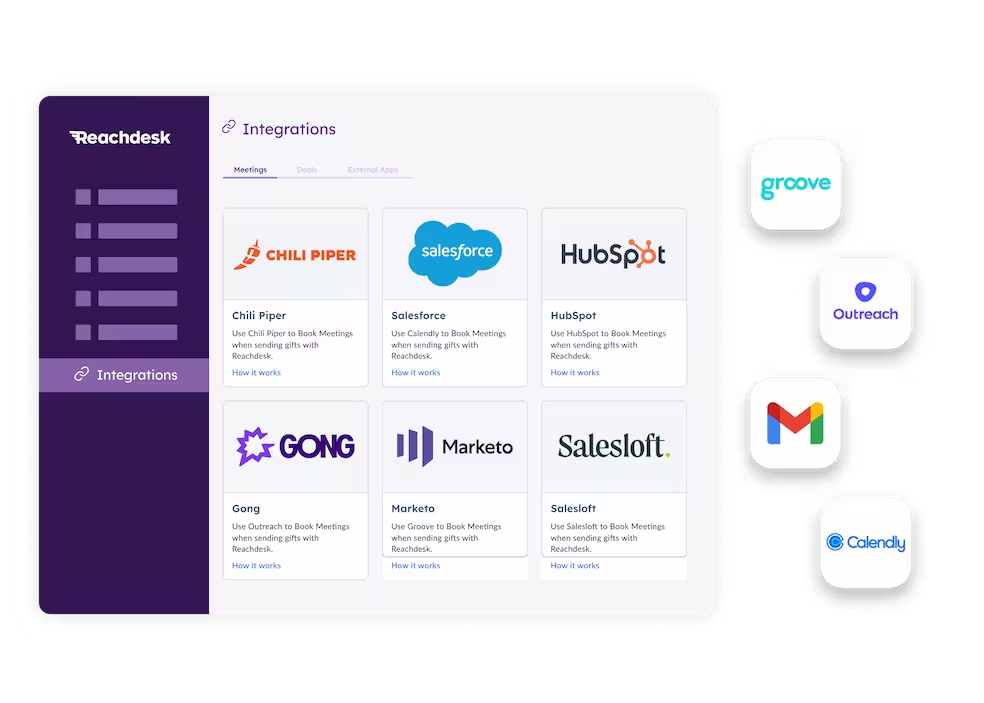
Your CRM already holds the signals that tell you when to send a gift. Deal-stage history, past conversation notes, and account-level engagement each point to a moment where a physical touchpoint can change a relationship's trajectory. Build these triggers directly into your CRM workflows so sends fire automatically when conditions are met, rather than depending on a rep to remember. When gifting is connected to deal stage data and account-level intent signals, it stops feeling like an interruption and starts feeling like the right thing at the right time.
| Trigger | Why it works |
|---|---|
| Deal stalled at a specific stage | Breaks the silence with something tangible rather than another follow-up email. |
| Meeting booked but not yet confirmed | Increases show rates by making the meeting feel real. |
| Prospect went dark after initial interest | Reopens conversations without putting them on the spot. |
| Multi-stakeholder account with low engagement | Creates a reason for a specific contact to share your message internally. |
| Post-meeting, no response to next steps | Gives a concrete reason to follow up with context. |
Stefano Iacono, Global Director of Marketing at 6sense, described exactly this kind of approach when discussing their Ninja Creami campaign on The Pattern Break webinar (Episode 2, 2026). Their team segmented target accounts by stage, used intent data to identify active interest, and built gifting into the sequence at specific conversion points: book a meeting, receive a gift card; show up, receive the product. The result was: 7-figure pipeline and 41 new opportunities.
The mechanic worked because it was built around data. The gift was timed to a specific action, targeted at a specific profile, and backed by account-level intelligence that made it feel genuinely relevant rather than opportunistic.
With a native CRM integration, platforms like Reachdesk make this kind of trigger-based gifting repeatable. Reps can send from inside Salesforce or HubSpot, gifting activity logs automatically, and attribution data ties back to opportunities so you can see which sends influenced pipeline.
3. Measuring the ROI of your gifting strategy

Gifting spend that cannot be tied to pipeline is impossible to justify and impossible to improve. Before you run your first campaign, define what success looks like across five metrics: meeting conversion rate, pipeline influenced, deal velocity, engagement rate, and return on gifting spend.
The most reliable way to isolate the impact of gifting is to run a control group: a segment of target accounts receiving standard outreach alongside a matched segment that receives gifting as part of the sequence. That comparison gives you clean data on lift rather than correlation, and it gives you something concrete to bring to leadership when you need to justify or scale the program.
Understanding the gifting metrics that matter:
- Meeting conversion rate: what percentage of gift recipients book or show up to a meeting?
- Pipeline influenced: what is the total value of opportunities where gifting was part of the outreach sequence?
- Deal velocity: do gifted accounts move through the pipeline faster than ungifted ones?
- Engagement rate: are recipients clicking, redeeming, or responding to follow-ups?
- Return on gifting spend: for every dollar spent on gifts and fulfillment, how much pipeline is generated?
Platforms like Reachdesk surface these metrics automatically through CRM-connected attribution reporting, so you are not relying on manual tracking to make the case to leadership.
4. Aligning sales, marketing and customer success around gifting

Gifting programs fail when sales, marketing, and customer success operate independently, each team sending without visibility into what the others are doing. To run coordinated gifting across all three functions, you need shared visibility into account-level activity, agreed-on trigger points for when gifting should be used, and a single platform all three teams can access and report from.
Where misalignment usually happens:
- Marketing runs a gifting campaign without telling the BDR team, so no one follows up
- Sales sends gifts on the fly without knowing that marketing has already been in touch with that account
- Customer success manages relationships without the tools or budget to grow them through gifting
- Budget ownership is unclear, so gifting happens reactively rather than as a planned part of the program
Natalie Marcotullio's team at Navattic built their Navattic Fanatics program as a joint initiative between marketing and customer success. The program combines in-person events across 12 cities with an online portal where customers earn points for specific actions and redeem them for gifts. Marketing runs the program. Customer success manages the relationships and growth opportunities. Both teams have visibility into who is engaging and what is working.
Reachdesk supports this through cross-team budget controls and campaign reporting, so marketing can plan and fund programs while giving sales and customer success the flexibility to execute them.
5. How to choose the right gifting play for each funnel stage
The most common reason gifting programs underperform is applying the same tactic uniformly across the pipeline. Each funnel stage has a different job for gifting to do, and matching the play to the stage is what separates a program that generates pipeline from one that generates goodwill and not much else.
Here’s an example of gifting plays the resonate at each stage:
- Early stage: building awareness and warming cold accounts. Gifting should create a reason to start a conversation rather than push for one. A well-timed gift with a note that says "we thought you might find this useful" lands better than one that asks for something in return. The goal is presence, not conversion.
- Mid-funnel: driving meetings and improving show rates. Use gifting as part of a coordinated motion; digital advertising builds awareness, intent data identifies active accounts, and gifting creates the pattern break that moves someone from aware to willing to talk. Tie the gift to a specific action and follow up with context.
- Late stage: accelerating deals and increasing stakeholder engagement. Multi-stakeholder deals stall when not everyone is equally engaged. A targeted gift to a specific contact, sent with a note that speaks to their specific concerns, can pull someone back into a conversation that has gone quiet and give your champion something tangible to share internally.
- Post-sale: retention, expansion, and advocacy. Some of the strongest gifting ROI comes after the deal closes. Customers who feel recognized are more likely to advocate, refer, and expand. A structured customer gifting program does not just create goodwill, it creates a community that generates pipeline.
When does corporate gifting fail to generate pipeline?
Corporate gifting fails to generate pipeline when it is treated as a standalone tactic rather than part of a coordinated go-to-market motion. The most common failure modes are sending without a follow-up sequence, running gifting outside your CRM so attribution is impossible to track, and scaling spend before the strategy is proven.
A gift without a follow-up is just a gift. A gifting program without CRM integration cannot prove its own ROI. And a budget without controls will grow in the wrong direction before anyone notices. Understanding where gifting breaks down is as important as knowing where it works, because the teams that see the strongest results are not necessarily spending more, they are spending with more structure around each send.
What to look for in a corporate gifting platform for building prospect relationships
The right corporate gifting platform needs six capabilities to run effectively at scale: native CRM integration, eGift billing on claim rather than on send, global fulfillment infrastructure, handwritten notes included in the platform price, campaign-level ROI reporting, and recipient choice. Without these six things, a gifting program either cannot scale, cannot prove its own ROI, or costs significantly more than it should. The difference between a platform built for one-off sends and one built for revenue teams running programs across hundreds of accounts comes down to whether these capabilities are native or bolted on.
| Capability | Why it matters |
|---|---|
| Native CRM integration | Gifting activity should log automatically, trigger sends, and pull attribution data back into your CRM without manual exports. |
| eGift billing on claim, not on send | Based on Reachdesk platform 2026 data, average eGift claim rates sit at approximately 30%, meaning charge-on-send billing can cost twice as much for the same number of delivered gifts. |
| Global fulfillment | Local warehouses in your key markets mean faster delivery and lower costs for international sends. |
| Handwritten notes included | A $4–12 per-note fee adds up quickly at volume (based on publicly listed competitor pricing, 2026). |
| Campaign-level ROI reporting | You need to see pipeline influenced and revenue attributed—not just open and claim rates—to understand performance and optimize future campaigns. |
| Recipient choice | Letting recipients pick their gift increases redemption rates and removes the risk of a missed preference. |
Reachdesk meets all six criteria above. Native integrations with Salesforce, HubSpot, Marketo, Salesloft, and Outreach mean gifting fits into existing workflows. Handwritten notes and warehousing are included in the platform price. eGifts are billed on claim, not on send. And the analytics connect every send to pipeline and revenue data.
The four things every prospect gifting strategy needs
A prospect gifting strategy generates pipeline when it has four things in place: timing that reflects where the buyer is in their journey rather than your campaign calendar, relevance that connects the gift to something you actually know about the person or account, coordination so the send is backed by digital presence and followed up properly, and measurement that ties results to pipeline metrics rather than engagement rates alone.
Miss any one of the four and the others weaken. A perfectly timed gift with no follow-up is a missed opportunity. A well-coordinated program with no measurement cannot prove its own value. All four need to work together for physical outreach to compound with the rest of your go-to-market motion rather than sit alongside it.
The teams generating the best results from gifting are not the ones sending the most. They are the ones who have built gifting into a repeatable, data-driven part of their go-to-market motion.
Frequently asked questions on gifting for building prospect relationships
1. What types of gifts are most effective for prospect engagement?
Gifts that reflect something specific about the recipient consistently outperform generic catalogue items. A gift connected to a prospect's industry, role, or a recent conversation signals that someone paid attention, and that signal is what creates a reason to respond. Recipient-choice options perform particularly well at scale because they remove the risk of a missed preference and put the decision in the hands of the person receiving it.
2. How do I measure the ROI of a corporate gifting strategy?
Track five metrics: meeting conversion rate, pipeline influenced, deal velocity for gifted vs. ungifted accounts, engagement rate, and revenue attributed to campaigns where gifting was part of the sequence. The most reliable way to isolate impact is to run a control group; a matched segment of accounts receiving standard outreach alongside one receiving gifting; so you are measuring lift rather than correlation. Without that comparison, it is difficult to separate the effect of gifting from everything else happening in the sequence. Reachdesk surfaces all five metrics automatically through CRM-connected attribution reporting, so the data is available without manual exports or spreadsheet tracking.
3. Can gifting be automated?
Yes. Trigger-based gifting; where a send is initiated automatically when a CRM field changes or a prospect takes a specific action; is one of the highest-performing use cases because it removes the reliance on a rep remembering to send at the right moment. A deal stalling at a specific stage, a meeting being booked, a prospect going dark after initial engagement: all of these can fire a gift automatically with a personalized note attached. Reachdesk integrates natively with Salesforce and HubSpot to make this fully automated while keeping personalization intact, so scale does not come at the cost of relevance.
4. How does gifting fit into an ABM strategy?
Gifting is one of the most effective ways to create a memorable touchpoint within an account-based marketing (ABM) program because it does something digital channels cannot: it creates a physical moment that a specific person at a target account will actually remember. Used at the right stage; typically once intent signals confirm active interest; it can move a target account from awareness to conversation faster than email or advertising alone. The key is timing it to account-level behavior rather than campaign dates. A gift sent because an account hit a specific intent threshold lands very differently from one sent because it is week three of a sequence.
5. How do I get started with gifting for building prospect relationships?
Start by identifying your highest-value use case: stalled deals, low meeting show rates, or cold target accounts that have not responded to digital outreach. Pick one, map the specific trigger that should initiate a gift, define the follow-up sequence that needs to happen within 48 hours of the send, and set the metrics you will use to judge whether it worked. Run a small test against a control group before scaling, this gives you clean data on lift and a defensible ROI figure to bring to leadership when you need budget to grow the program.
Turn corporate gifting into a relationship-building revenue channel
The best gifting programs don't rely on bigger budgets, they rely on better timing, stronger personalization, and clear measurement. Reachdesk helps revenue teams automate gifting from their CRM, personalize every send at scale, and track the impact on pipeline and revenue. Book a demo to see how leading B2B teams are using gifting to create more meaningful buyer interactions and accelerate growth.