
If you work in B2B marketing or sales, this probably feels familiar.
Buying group engagement has become one of the hardest parts of modern pipeline growth, even if your team is doing everything “right.”
You spend weeks planning a campaign. You tweak the messaging. You personalize subject lines. You hit send.
And then… nothing much happens.
Open rates flatten. Clicks trickle in. Replies are rare. Pipeline reviews get uncomfortable because activity looks high, but progress does not.
This is not because your team is bad at email.
It is because email-first engagement is no longer built for how B2B buying actually happens.
Today’s B2B decisions are made by groups, not individuals. And most engagement strategies still assume that if you convince one person, the rest will fall into place.
They usually do not.
If B2B buying group engagement feels harder than it used to, the issue is not volume. It is relevance, timing, and whether you are actually reaching the people who matter.
Why B2B deals stall when you only engage one person
Most B2B deals do not stall because interest disappears. They stall because the buying group never lines up.
Today, decisions are made by six to ten stakeholders, not one. Each person brings different concerns and veto power, from budget and risk to security, contracts, and adoption.
If any one of them is unsure, progress slows. If several are unsure, the deal stops.
Research from B2Belive shows that over 40% of B2B deals get stuck because the buying committee cannot make a decision. Not because the solution is wrong, but because the group never gets aligned.
Most GTM teams unintentionally make this harder by focusing almost entirely on the champion. One sequence. One set of messages. One point of view.
That forces the champion to do the internal selling alone, answering questions they were never meant to handle. That is why deals stall even when enthusiasm is real.
This is not a sales problem. It is an engagement problem.
Why email-first engagement fails with buying group engagement
Email is not broken. It is just not built for buying groups.
Inboxes are crowded. Messages arrive at the wrong time. And a single email cannot answer the very different questions a CFO, an IT leader, and an executive sponsor are all asking.
Even when emails are opened, they rarely stick. There is no experience attached to the message, nothing memorable to carry into internal discussions.
Buying groups move forward when confidence builds across roles. Email alone struggles to create that shared confidence, especially in complex decisions.
That is why email-first engagement often leads to early interest, followed by silence.
But it’s not all doom and gloom, some of the best go to market teams found a solution that engages all buyers in the committee, without breaking the bank.
How GTM teams shift from single-thread to buying group engagement
Teams that consistently engage buying groups well have made a clear shift.
They stop asking, “How do we send more messages?”
They start asking, “How do we create moments people actually want to engage with?”
Their outreach is designed to:
- Reach multiple stakeholders on purpose
- Share insight that genuinely helps each role think more clearly
- Feel human and thoughtful, not automated
- Show up when attention is available, not just when a sequence says so
This shift is exactly why strategic gifting has become such a powerful engagement channel when it is done properly.
Not as a gimmick. Not as a last resort. As a deliberate way to earn attention and start better conversations.
Why strategic gifting succeeds where email falls short
When thoughtful gifting is paired with relevant content and good timing, the difference is obvious.
Data cited in the ebook shows:
- Open rates above 85 percent
- Click-through rates around 58 percent
- Conversion rates that far outperform traditional email
This is not about generosity. It is about how people respond.
A gift cuts through digital noise. It creates a pause. It signals effort. When it is paired with content that actually matters to the recipient, that content is far more likely to be read, remembered, and shared internally.
That is the difference between sending information and creating engagement. And it only works when gifting is intentional, not random, guided by clear insight, format, and timing. That structure is the G.I.F.T framework.
Introducing the G.I.F.T framework for buying group engagement
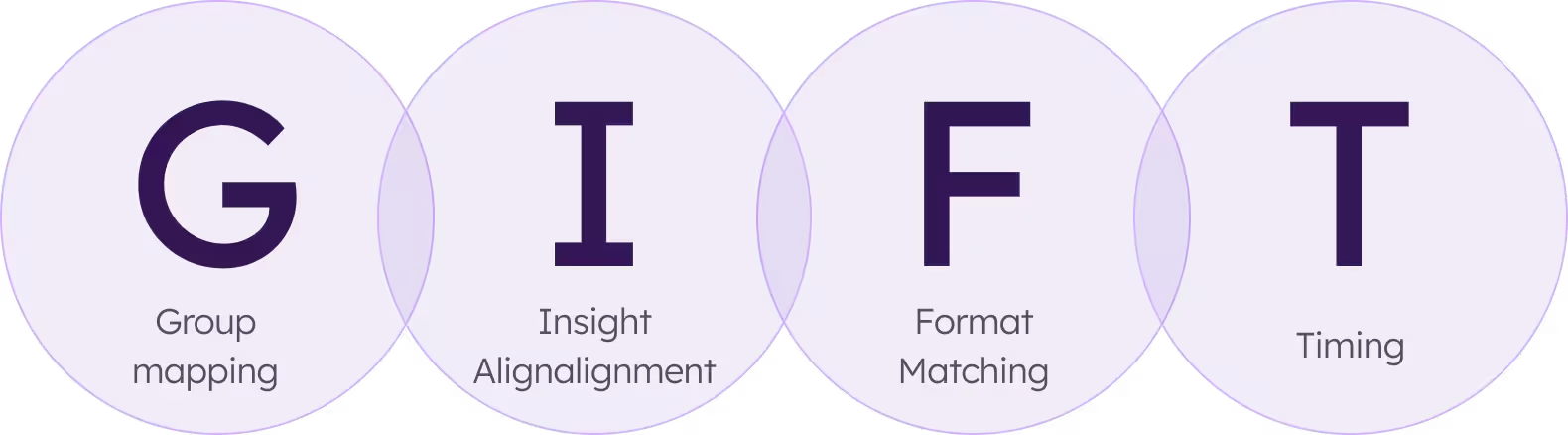
The G.I.F.T framework exists because engaging buying groups requires coordination, not guesswork. Here’s how we break it down:
G: Group mapping
Before outreach begins, identify everyone involved in the decision. Decision-makers, influencers, evaluators, and blockers. This avoids last-minute surprises and keeps engagement from relying on a single champion.
I: Insight alignment
Each stakeholder receives content designed for their priorities. Not product brochures, but insight that helps them evaluate the decision from their perspective.
F: Format matching
The gift supports the content experience. Different roles respond to different formats depending on mindset and stage.
For example, a CTO may respond well to tech like high-end noise-councelling headphones that helps them focus accompanied by a solution implementation guide, whilst the end-user may respond better to a branded coffee bundle with an invite to a webinar on how to get the best results from your solution.
That’s why it’s essential to pick your gift wisely, and pair it with the right content at the right time.
T: Timing orchestration
Engagement is driven by signals, not internal calendars. Job changes, content engagement, planning cycles, and stalled deals all create natural moments to reach out.
When these four pieces work together, buying group engagement becomes intentional instead of reactive.
The buyer awareness gifting play: One G.I.F.T play you can run today
At the awareness stage, you are not trying to force a meeting. You are trying to show up in a way that feels relevant and worth responding to.
This is one of the simplest buying group engagement plays to run, and it works because it is focused, human, and easy to execute.
How to run the buyer awareness gifting play: A step by step guide
1. Start with a short, high-value list
Identify 20 to 30 people inside your target accounts who are likely to influence future decisions. Fewer names, more intention.
2. Do just enough research to earn attention
Look for one or two real signals. A post they shared. A challenge they mentioned. An event they spoke at. You are not looking for everything, just something specific.
3. Share content that helps them think
Choose one asset that speaks directly to their role. A benchmark, a short guide, or peer insight. No product decks.
4. Pair it with a simple, familiar gift
Coffee, tea, branded treats, or a food delivery voucher work well at this stage. The gift lowers friction. The content does the work.
5. Keep the message human
Reference the signal you noticed and explain why the content might be useful. Do not ask for time. Do not pitch.
6. Follow up while the moment still matters
Reach out within 48 hours of redemption. Focus on the content, not the gift. This is where most replies happen.
The results teams typically see from this gifting play
- 25 to 35 percent response rates
- Early conversations instead of cold replies
- Faster recognition when future outreach happens
This is just one play.
If you want the complete playbook, it’s all there, and it’s ungated.
The full G.I.F.T framework ebook breaks down proven gifting plays for every stage of the buyer journey, from early awareness to deal acceleration and customer expansion, with real examples, budgets, and timing guidance.
Start engaging the entire buying committee with G.I.F.Ts today
If your pipeline depends on one person selling internally on your behalf, growth will always be unpredictable. Deals slow down. Momentum fades. Forecasts get shaky.
Buying group engagement is no longer optional. It is how B2B decisions actually get made.
The teams pulling ahead are not sending more emails. They are showing up with the right message, for the right people, at the right moment.
This article introduces the challenge and one proven approach. The complete playbook lives in the G.I.F.T framework ebook.
Inside, you will find:
- Proven gifting plays for every stage of the buyer journey
- Real message examples that earn responses
- Clear budget guidance by persona and buying stage
- Timing strategies backed by real engagement data
- Measurement frameworks that connect engagement to pipeline impact
FAQ Section:
What is B2B buying group engagement and why does it matter?
B2B buying group engagement means reaching every person involved in a purchase decision, not just the one you are already talking to. Today, most B2B decisions involve six to ten stakeholders across finance, IT, operations, and the executive team. If the rest of the group is not informed and not confident, the deal stalls. Not because interest is gone, but because the committee never lined up.
Why does email fail to engage B2B buying committees?
Email is not broken. It is just not built for buying groups. Inboxes are crowded. Messages arrive at the wrong time. And a single email cannot answer the very different questions a CFO, an IT leader, and an executive sponsor are all asking at the same time. Even when emails get opened, they rarely stick. There is no experience attached, nothing memorable to carry into internal conversations. Buying groups move forward when confidence builds across roles. Email alone struggles to create that.
What is the G.I.F.T framework for buying group engagement?
The G.I.F.T framework is how Reachdesk structures buying group engagement so it becomes intentional instead of reactive. G is for Group mapping — identifying every decision-maker, influencer, and blocker before outreach begins. I is for Insight alignment — giving each stakeholder content that speaks to their specific priorities, not generic product material. F is for Format matching — pairing the right gift to the right role and stage. T is for Timing orchestration — reaching out based on real buyer signals like job changes or content engagement, not just when a sequence tells you to. When the four pieces work together, engaging a buying committee stops feeling like guesswork.

.avif)