
Your event was a hit. Can you prove it?
The booth was packed. The dinner sold out. Your team came home buzzing.
Then your CFO asks one question: what did we get for it?
If your answer is a badge scan count, you have a problem. Events are one of the biggest lines in your marketing budget. They deserve better proof than "people showed up."
To measure event ROI, subtract your total event cost from the revenue attributed to the event, divide by the total cost, and multiply by 100. To make that number credible to finance, you need three things: every cost in one place, every attendee and deal tied to the event in your CRM, and reporting that runs for months, not days. This guide gives you the event ROI formula, the metrics that actually matter, and a 5-step process you can run on your next event.
Why most event ROI measurement falls short
Most teams measure what is easy to count. Attendees. Booth visits. Leads scanned. Those numbers feel good, but they don't tell you if the event made money.
Here is where event ROI usually breaks down:
- You stop tracking when the event ends. B2B deals take months to close. If you report ROI the week after, you miss most of the revenue the event influenced.
- Your leads go cold. Sales gets a spreadsheet of names two weeks later. By then, nobody remembers your booth.
- Costs live in five places. Venue, travel, swag, shipping and staff time sit in different budgets. You can't calculate a return if you don't know the real cost.
- Nothing connects back to the CRM. If attendees, meetings and deals aren't tied to the event in Salesforce or HubSpot, attribution becomes guesswork.
The good news? Every one of these is fixable before your next event.
The event ROI formula
Event ROI compares the revenue an event generated with what it cost you. Here is the standard formula:
Event ROI (%) = [(Revenue attributed to the event − Total event cost)
÷ Total event cost] × 100
Here’s a worked example:
Say you host a three-city executive dinner series. And this is what they cost you:
That gives you ($240,000 - $60,000) / $60,000 × 100 = 300% ROI. Every dollar you spent brought back four.
Two checks keep this number credible. First, count only the revenue your attribution model credits to the event, not the full value of every deal an attendee touched. Second, ask finance whether they measure return on revenue or on gross margin. Margin gives a lower, more conservative ROI, so agree on one before you report.
How to measure event ROI before deals close
Event-generated revenue can take two or three quarters to materialize, but that doesn't mean you have to wait to prove impact. Start by measuring pipeline ROI, using the same ROI formula above but replacing revenue with qualified pipeline created or influenced by the event.
Track how many opportunities your event generated, their total pipeline value, and how those deals progress through the sales cycle. This gives marketing and finance an early view of event performance while revenue is still in motion.
As deals close, update your reporting with actual revenue ROI. That way, your CFO gets both an early indicator of pipeline impact and a clearer picture of the event's final financial return.
Which attribution model should you use for event ROI?
Use the model your company already reports on, so event numbers line up with every other channel. Whichever model you pick, report two views side by side:
- Sourced pipeline: opportunities the event created
- Influenced pipeline: existing opportunities that had an event touchpoint before they closed
First-touch models favor events that bring in net-new accounts, like trade shows. Last-touch models rarely credit events, because deals close long after the booth comes down. Multi-touch models share credit across every touchpoint, which suits executive dinners and customer events that move deals already in progress. Agree on the model with finance before the event, not after the results come in.
The event ROI metrics that matter
Revenue is the end goal, but it isn't the only signal. Track these metrics across the full event lifecycle so you can see what's working long before deals close.
Pick three to five of these and agree on them with sales before the event. Shared targets make the final report easy to trust.
How to measure event ROI in 5 steps
To measure event ROI accurately, start with a clear business goal, track every event cost, and connect attendee engagement to pipeline and revenue in your CRM. The key is to measure performance throughout the sales cycle, not just immediately after the event. Follow these five steps to prove event marketing ROI and make smarter decisions about future investments.
- Set one goal per event. Pipeline, expansion or retention? A customer dinner and a trade show booth need different scorecards. Write the goal down and get sales to sign off.
- Build your target account list first. Decide who you want in the room before you plan anything else. ROI starts with the right audience, not the biggest one.
- Capture every cost in one place. Venue, travel, staff time, swag, gifts and shipping all count. If you leave costs out, your ROI looks better than it is, and finance will notice.
- Tag everything in your CRM. Create an event campaign in Salesforce or HubSpot. Log registrations, attendance, meetings and follow-ups against it so every deal can trace back to the event.
- Report at 30, 90 and 180 days. Share early signals at 30 days, pipeline ROI at 90 and revenue ROI at 180. Then use what you learn to plan the next event.
How to measure ROI for different event types
Not every event should be judged the same way. A 5,000-person trade show and a 12-seat executive dinner do very different jobs. If you hold them to the same scorecard, one will always look like a failure.
Match your lead metric to the job each event is doing:
Here is the pattern. The bigger and broader the event, the more you lean on volume metrics like meetings and pipeline. The smaller and more exclusive the event, the more you lean on quality metrics like deal velocity and progression.
An executive dinner might create zero new opportunities and still be your best event of the year. If it moves three stalled enterprise deals forward, that's real revenue impact. Just make sure you track it that way, so the dinner gets credit for the deals it helped close.
5 event ROI mistakes to avoid
Common event ROI mistakes include counting unqualified leads, overestimating revenue attribution, overlooking hidden costs, and failing to track post-event results. These errors can inflate your ROI, hide underperforming campaigns, and make it harder to justify future event budgets. Avoid these five mistakes to keep your event ROI reporting accurate and actionable.
- Counting every attendee as a lead. A student, a competitor and a vendor all scan the same badge. Filter your list against your ICP before you hand it to sales, or your conversion rates will look worse than they are.
- Claiming 100% of every deal. If an account attended your event and also saw six ads and two webinars, the event didn't win the deal alone. Agree on an attribution model with finance up front and stick to it.
- Forgetting staff time. Your team's hours are a real cost. Ten people spending three days at a show adds up fast, even if it never shows up on an invoice.
- Following up too slowly. Interest fades fast after an event. Book follow-up meetings onsite where you can, and get your post-event outreach out within days, not weeks.
- Only reporting the wins. If an event didn't deliver, say so. An honest report builds trust with finance, and it helps you move budget to the events that actually work.
Where gifting and swag fit into event ROI
Gifting and swag can improve event ROI by increasing registrations, driving booth engagement, and converting event conversations into qualified pipeline. Rather than treating them as promotional expenses, use them strategically before, during, and after events to create memorable experiences and measurable business outcomes.
- Before the event: Send a personalized gift with your invite to target accounts. It gets you noticed in a crowded inbox and lifts registrations from the people you actually want.
- During the event: Skip the stress ball. Offer something worth taking home, or let attendees choose a gift delivered straight to their door. No extra luggage, a memorable experience, and a natural reason for your sales team to follow up when the gift arrives.
- After the event: Follow up with a thoughtful gift tied to your conversation. It's a reason to reconnect while the event is still fresh.
How Workhuman booked 43 meetings with event gifting
Reachdesk customer Workhuman runs Workhuman Live, its annual HR conference. Its demand gen team uses gifting on both sides of the event, after one year's conference and ahead of the next, and tracks the results of every campaign.
Before the event: Workhuman sent 75 World Gratitude Day bundles with a gratitude journal, a pen set and a code for $100 off a conference ticket. The bundles drove 32 ICP responses, 9 meetings, 1 influenced opportunity and 6 progression opportunities.

After the event: The team sent 100 "Fuel Your Focus" boxes to attendees. Each box had a branded tumbler, locally roasted coffee and a book by one of the keynote speakers. The results:

Across three gifting campaigns in 12 months, Workhuman reached more than $10 million in influenced pipeline and more than $70 million in opportunity progression. Recipients claimed 96% of the 1,355 gifts the team sent.

The key is tracking. When every gift and swag send is tied to a contact and an event campaign in your CRM, you can see exactly which sends led to meetings and pipeline. That turns a line item into a lever.
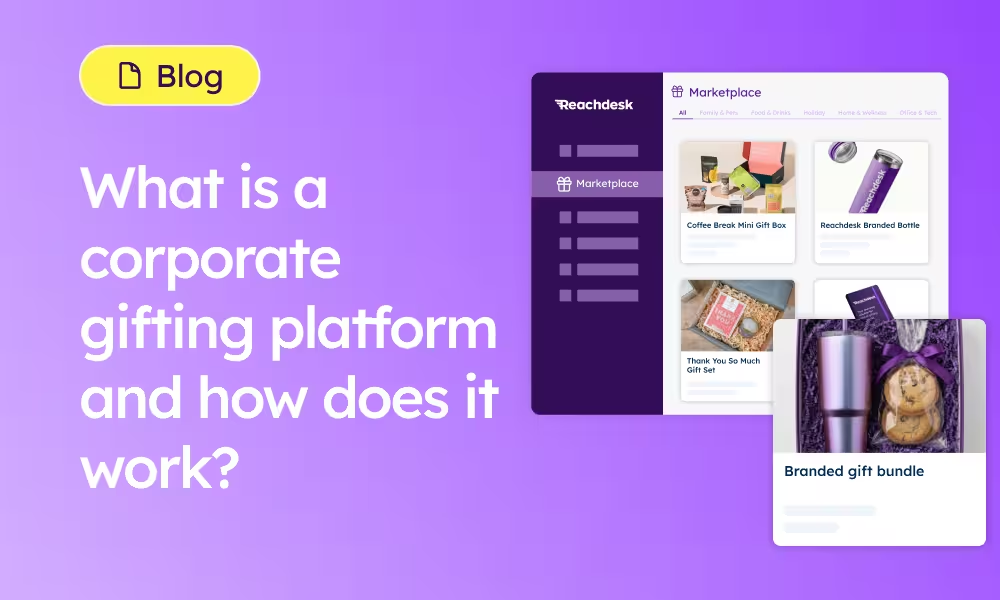
Reachdesk is a gifting platform that brings event fulfillment, swag, and gifting into one place, connected to Salesforce, HubSpot, and Marketo. Every send is tied to a contact and a campaign, so you can see what you sent, who engaged, and the pipeline it influenced.
Event ROI FAQs
What is event ROI?
Event ROI is the return you get from an event compared with what it cost. You calculate it by subtracting total event cost from attributed revenue, dividing by total cost and multiplying by 100.
What is a good ROI for a B2B event?
It depends on the event type and your sales cycle. A useful benchmark is your own past events. Compare cost per meeting, cost per opportunity and revenue ROI across events to see which formats earn their budget.
How long should you wait to measure event ROI?
Track early signals within 30 days, pipeline ROI around 90 days and revenue ROI at 180 days or longer. B2B deals rarely close in a week, so a single report right after the event will undercount results.
What costs should you include?
Include every cost: venue, catering, travel, staff time, promotion, swag, gifts and shipping. Leaving costs out inflates ROI and erodes trust with finance.
How do you attribute revenue to an event?
Create an event campaign in your CRM and log every touchpoint against it, including registrations, meetings, gifts and follow-ups. Then report on deals from attending accounts that had event touchpoints before they closed.
What is the difference between event ROI and event marketing ROI?
Event ROI usually measures a single event against its own costs. Event marketing ROI looks at your whole events program over a quarter or a year. Use event ROI to judge one event, and event marketing ROI to decide where next year's budget goes.
How do you calculate cost per meeting?
Divide your total event cost by the number of qualified meetings it produced. For example, a $60,000 event that drives 40 meetings costs $1,500 per meeting. Track it across events to see which formats give you the most conversations for your budget.
Can gifting improve event ROI?
Yes, when you track it. Pre-event gifts can lift registrations from target accounts, and post-event gifts give you a reason to follow up while the event is fresh. Workhuman's post-event gift boxes delivered by Reachdesk turned 100 sends into 34 meetings.
What's the difference between gifting ROI and event ROI?
Gifting ROI measures what you spend on gifts and swag against the pipeline and revenue those sends influence. Event ROI measures the whole event against its total cost, with gifts as one line item. Log gift sends against the event campaign in your CRM so you can report both: the event's overall return and how much gifting contributed to it.
How do you measure ROI for a brand awareness event?
Agree on a measurable proxy with sales and finance before the event, such as target account attendance, meetings held, or follow-up response rate. Then check whether attending accounts move through your pipeline faster than similar accounts that didn't attend. If you can't connect an event to pipeline at all, report it as a brand investment, not a revenue one.
Drive more event ROI with smarter gifting and fulfillment
Great events build relationships. Great measurement keeps the budget coming.
Start with one goal, the right accounts and every cost in one place. Tag it all in your CRM and report over months, not days. Do that, and your next ROI conversation with finance gets a lot shorter.
Want every event send to show up in your ROI report? See how Reachdesk ties event fulfillment, swag, and gifting to contacts and campaigns in your CRM, so you can prove the pipeline your events create.