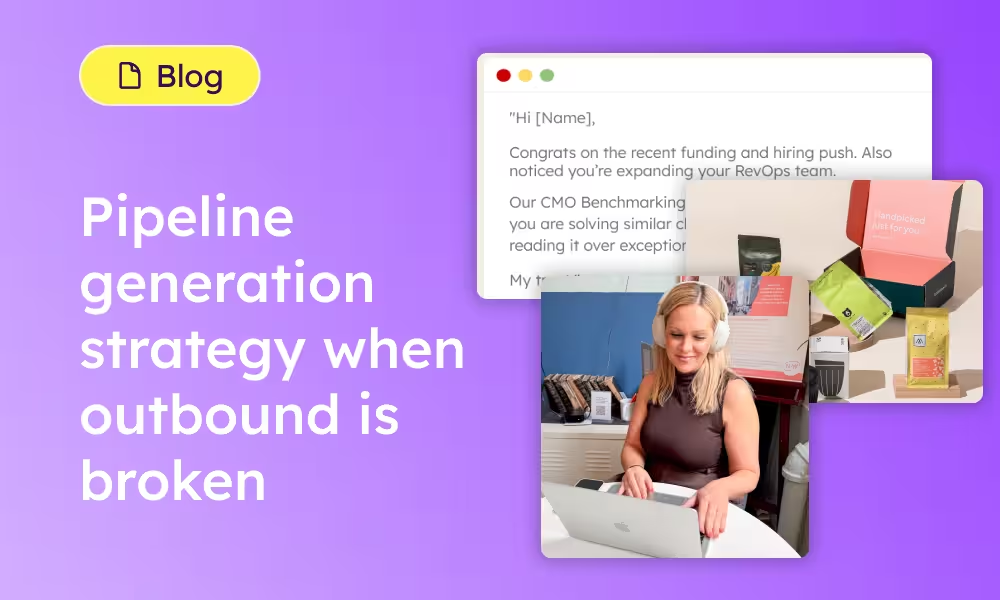

An event swag strategy is a plan for using trade show giveaways, gifts, and branded items before, during, and after a conference to book meetings, start qualified conversations, and keep deals moving once everyone flies home. It treats swag as part of your go-to-market motion, not a box of leftovers on the booth table. Done well, event swag shows up in your pipeline report, not just your shipping invoice.
Here's the uncomfortable truth about most trade show giveaways. They get scooped up by people who will never buy, stuffed into a tote, and abandoned in a hotel room on day three. Your team spends weeks on the order. The booth looks busy. A month later, nobody can point to a single opportunity it created.
The good news? Event swag doesn't have to work that way. Between September and November 2026, the Reachdesk team ran 11 events, anchored by HubSpot UNBOUND (formerly INBOUND) in Boston and 6sense Breakthrough in Las Vegas. We ran every gift, swag send, and booth activation through our own platform, and we tied each one to a meeting or a pipeline goal before a single box shipped.
This guide breaks down exactly how we do it: the framework, the plays, the budgets, the follow-up templates, and the mistakes we learned from the hard way. Use it to build a trade show marketing plan where every giveaway has a job to do.
Why most event swag fails to drive pipeline
The problem with most event swag isn't the item. It's the intent behind it. When swag is ordered as a line item instead of planned as a strategic event marketing play, it can't do much more than fill a table.
1. Event swag gets treated as a task, not a motion
Teams tend to approach event swag in one of two ways. Some see it as a box to tick: order whatever's trending, ship it to the venue, move on. Others tie it to the numbers that matter, like meetings booked, qualified leads, pipeline, and revenue, and plan the swag around supporting the BDRs and AEs working the floor. Only the second approach gives you something to report on after the show.
2. Everyone gets the same swag
A booth that hands the same pen to a student, a competitor, and the VP on your target account list is optimizing for volume. Volume looks great in a badge-scan count. It does very little for trade show ROI, because the people you most want to talk to get nothing that makes them feel singled out.
3. The event giveaway ends the conversation instead of starting it
If someone can grab your best item, smile, and walk away, the exchange is over. Great event gifting does the opposite. It gives people a reason to book time, come back to the booth, or hear from you again once they're home. That's the shift this event swag playbook is built on.
The event gifting framework: Gift before, during, and after
The simplest way to make event swag work harder is to stop thinking of it as a booth problem. At Reachdesk, we gift at all three stages of every event, and each stage has one clear job.
The thread running through all three is what we call a hero item. It's one standout piece of swag, built around a campaign story, that people actually want and can't get just by walking past. A hero item works as a conversation starter on the floor and a little badge of belonging after the show. When someone asks where it came from, the answer is your story.
The sections below walk through the exact plays we run at each stage, what we spend, and what they return.
Pre-event swag: How to book meetings before you land
The best meetings at any show are booked two to three weeks before it starts. Once attendees are on the floor, their calendars fill with sessions, dinners, and every other vendor fighting for the same 20 minutes. A strong pre-event gift offer gets you on the calendar first.
Lead with a hero item people want to earn
For HubSpot UNBOUND, our hero item was a custom denim jacket printed with our campaign line, "From URL to IRL." There was no way to grab one at the booth. Prospects booked a 30-minute meeting in advance, picked their jacket size on our branded gifting landing page, and collected it on-site with a handwritten note.
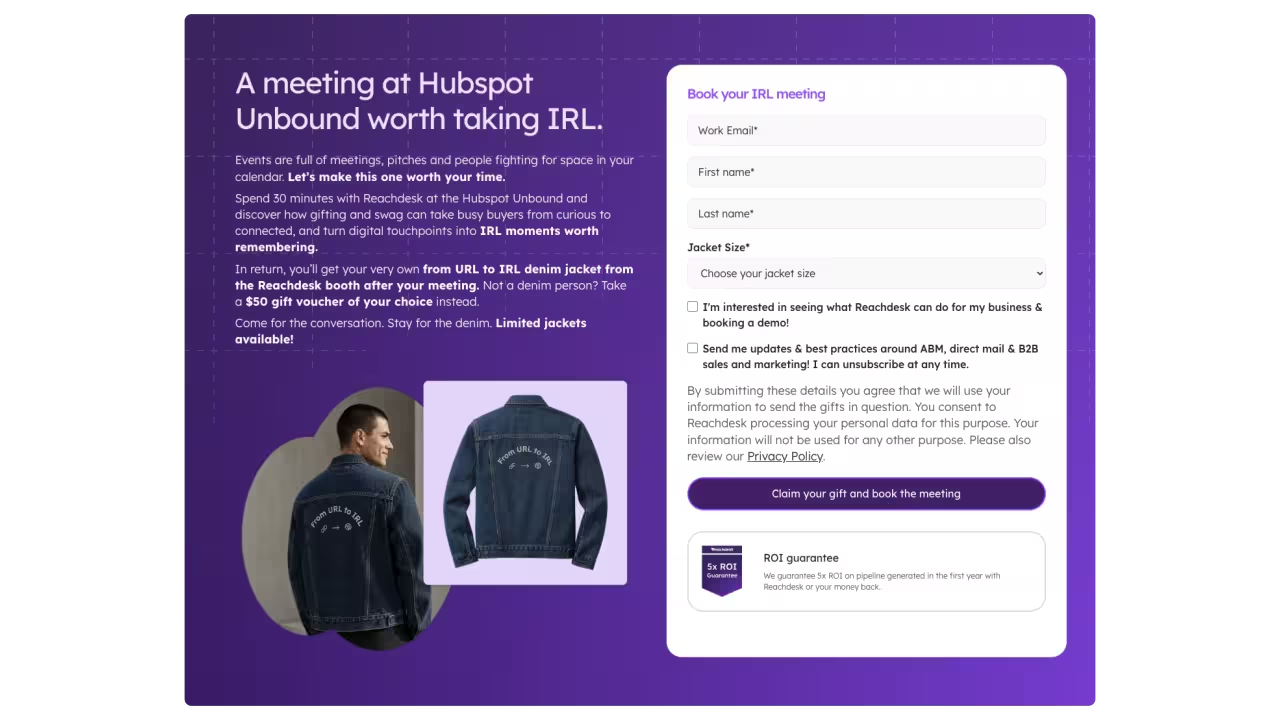
We paired the landing page with an email campaign and a booking link that dropped meetings straight onto our team's calendars. The result: 25 pre-show meetings and back-to-back calendars before the doors opened. Not a denim person? Prospects could choose a $50 gift voucher instead, so the offer never became a barrier.
The jacket also skipped heavy corporate branding. The campaign line did the talking, which made people ask where it came from. That question is the start of a conversation you didn't have to pitch for.
Make the offer worth the walk
At Demandbase GO NYC, our hook was simple: "Thirsty for pipeline? Let's meet." Prospects booked 20 minutes with our team and picked up a custom Reachdesk Owala water bottle at the booth after the meeting, with a $50 voucher as the alternative.
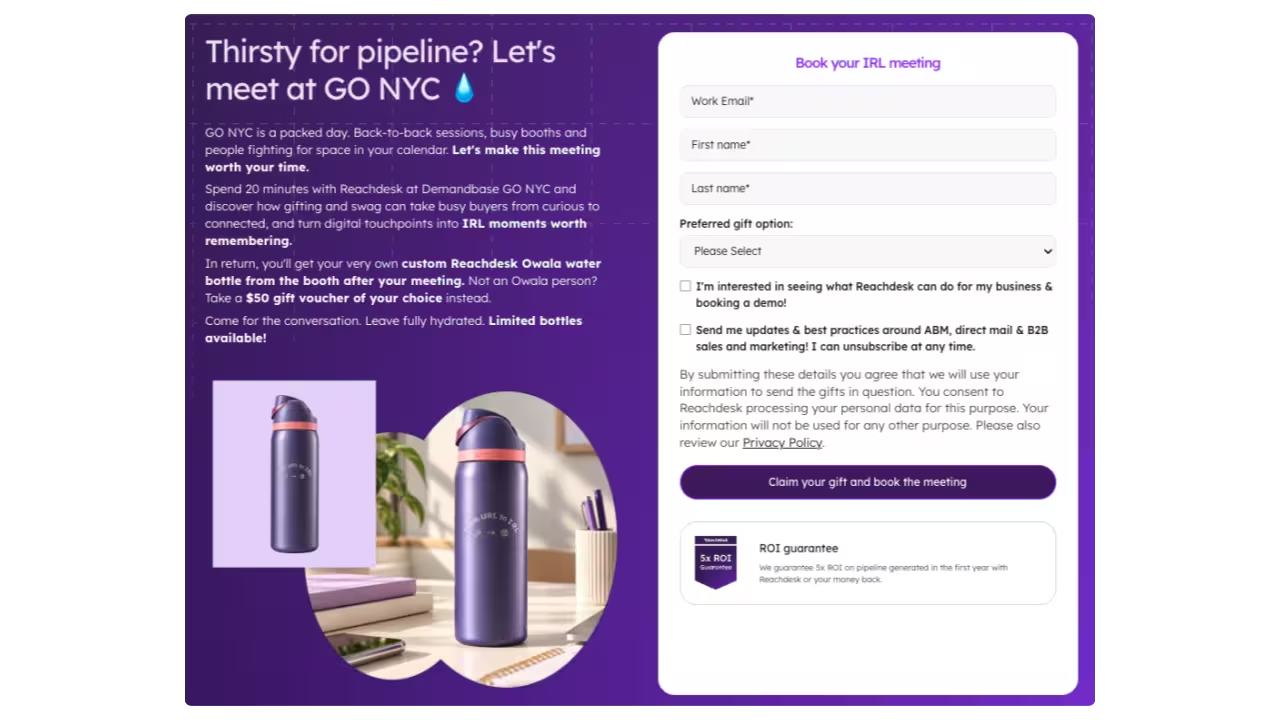
This play creates awareness and pipeline before the event has even started. We recommend budgeting $30 to $200 per gift, depending on your ACV and the opportunity value of the account.
Give multi-day attendees something to look forward to
Three days on your feet is exhausting, and buyers know it. For multi-day shows like Breakthrough and NRF, we offered a $100 spa voucher in exchange for a 30-minute strategy call. The message was built around rest, not a pitch: after three days on the floor, relax with a spa gift on us.
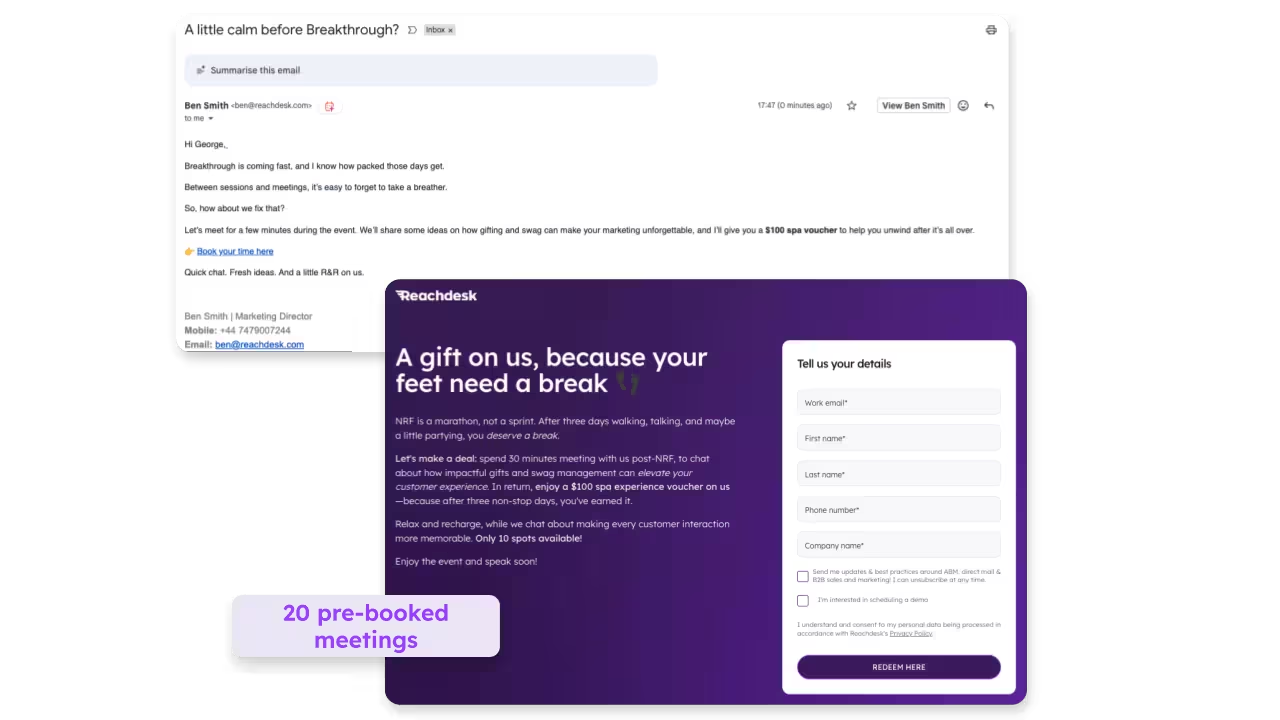
It booked 20 meetings before the event. Events need offers too, and a gift that solves a real attendee pain point is one of the easiest ways to get a yes. Budget around $100 (or £50 in the UK) per gift.
Save a premium kit for tier-one prospects
For our highest-priority accounts at Breakthrough, we sent invitations to claim a Reachdesk instant camera kit, complete with film and a branded carry case. Prospects booked a slot, met us at the show, and chose their gift. We tied the kit to an influencer campaign with 15 creators producing unboxing videos and capturing in-real-life moments at the event, so the campaign story lived well beyond our booth.
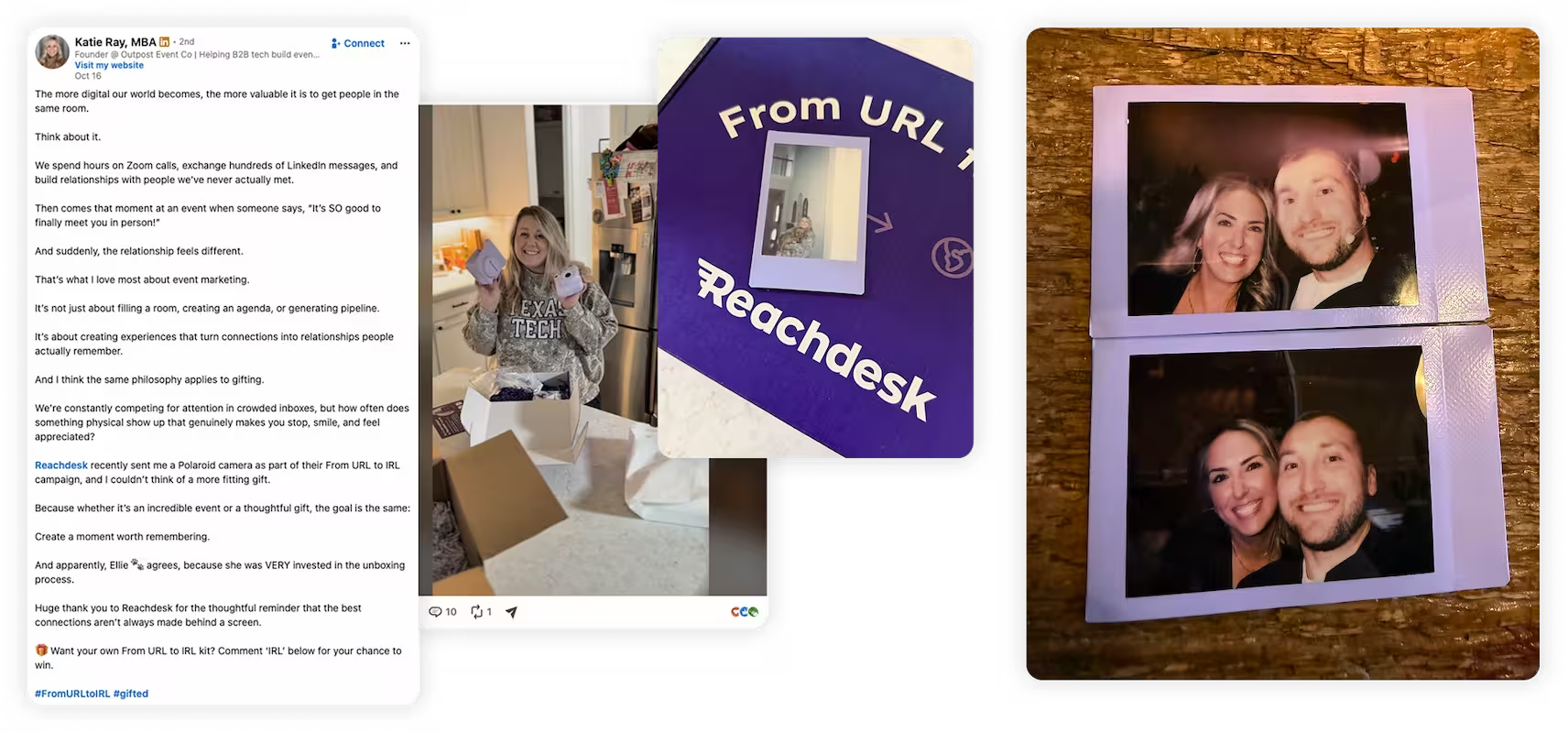
Pre-event messaging templates you can steal
Book before you land. Send two to three weeks out. This is where the meetings come from.
"Hi [Name]. I saw you're going to [Event]. Rather than fight for your attention on the floor, shall we get 20 minutes booked? Sending coffee for the flight either way."
The exec invite. Best for senior recipients you'd never get on a demo.
"Hi [Name]. We're hosting a small dinner at [Event] on [date], eight people, no presentation. Sending the invite with something for the trip. Say yes and I'll hold you a seat."
Conference swag: How to earn conversations during the event
Once the doors open, your job shifts from booking time to earning attention. Every booth on the floor is competing for the same eyes. The conference swag that wins is the kind that interrupts the pattern and gives someone a reason to stop.
Use room drops to start conversations before the floor opens
At Breakthrough, we left a pickleball set in attendees' hotel rooms with a simple invitation: here's your pickleball set, come to the booth for a game. By the time people reached the expo hall, they already had a reason to find us. The court at our booth did the rest, turning a gift into foot traffic and a shared moment.
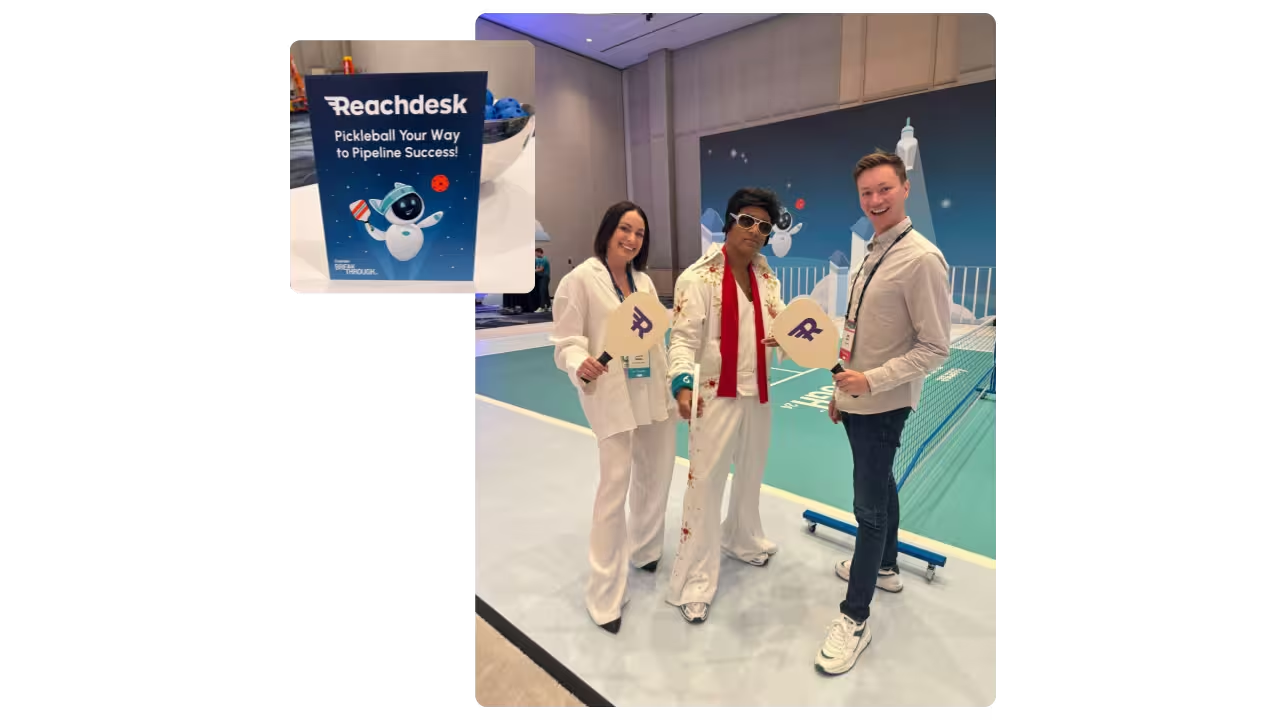
Room drops create conversations before the event and deliver a pattern interrupt that drives booth traffic. Plan for $75 to $200 per gift, depending on ACV and opportunity value.
Create a brand moment people remember
Inspired by Seth Godin's idea of the purple cow, one of our most memorable activations put purple light-up cowboy hats on attendees and a mechanical bull in the middle of a packed trade show. The message: be unforgettable like a purple cow.
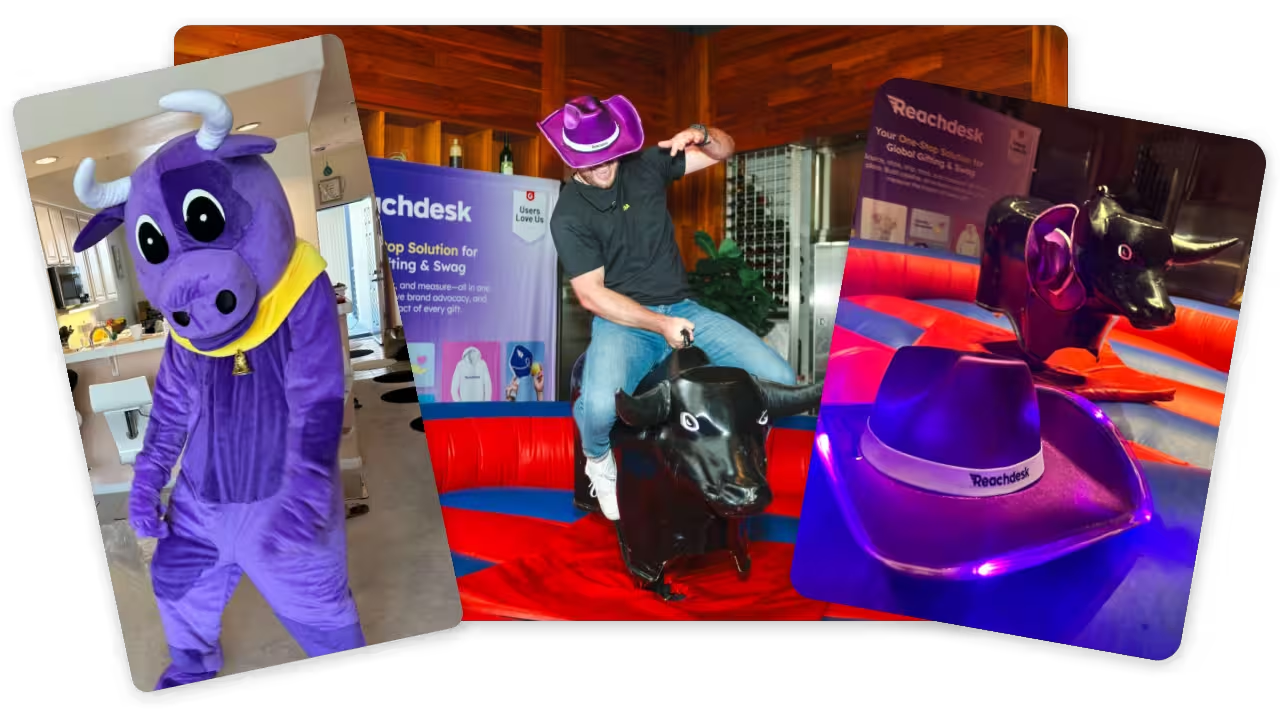
In a crowded event space, a moment like that is shareable, talked about, and easy to remember. It also works on a modest budget, at around $10 to $50 per item. The best activations do one thing well: they make people ask, "Where did you get that?"
Hold back your best swag for real conversations
Giving everything away at the booth is the fastest way to lose your reason to follow up. Instead, we use a swag store portal. Attendees scan a QR code, browse the store, and add an item to their cart. The checkout code only unlocks after an in-person conversation at the booth.
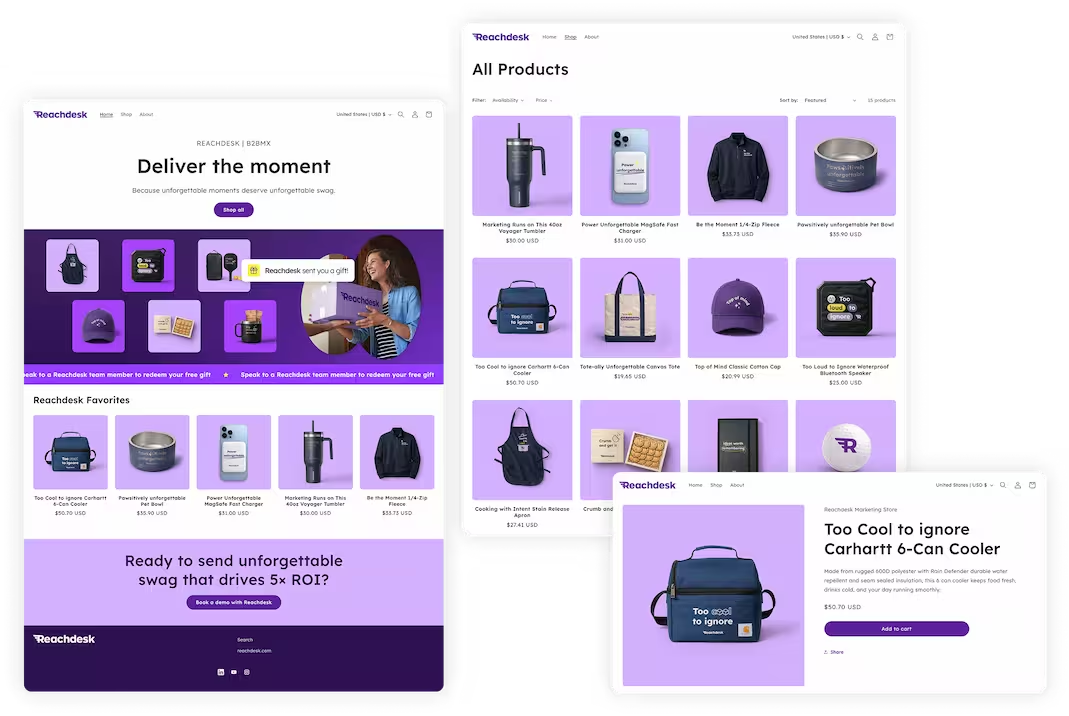
The item ships to their home after the show, which hands your sales team a natural, well-timed reason to reach out when it arrives. One note from experience: this only works with full buy-in from your booth staff. If the team on the stand isn't committed to qualifying conversations, the portal becomes another freebie.
At-event template: Claim at the booth
Best for driving booth traffic without a scanner queue.
"Hi [Name]. You're on my list for [Event]. Come to booth [number] and the gift's yours. Two minutes, no pitch. If you want the longer version, we'll book it properly afterward."
Post-event gifting: How to stop pipeline from dropping off
Pipeline drops after every event. Attendees fly home to a full inbox, and your booth conversation slips down their list. Post-event gifting keeps you in the picture long enough to turn a good chat into a booked meeting.
Send it home, not in their suitcase
Nobody wants to squeeze a fleece and a tumbler into a carry-on. Our message for this play is simple: no room in your luggage, no problem, here's a gift sent home after the event. Attendees pick from our Reachdesk swag store, and the item lands on their doorstep days later, right when your follow-up email does.
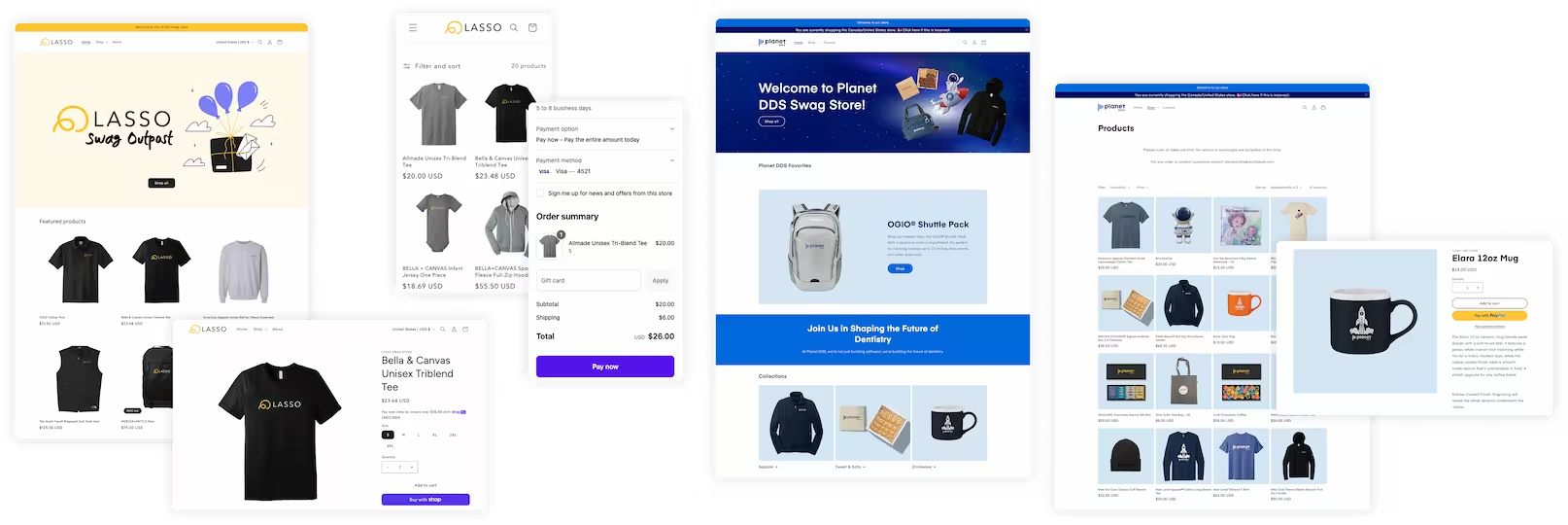
It keeps the conversation alive at the exact moment most vendors go quiet. Budget $50 to $150 per gift, depending on ACV and opportunity value.
Nurture with a seasonal hook
Not every lead is ready to talk the week after a show. For those contacts, we fold a seasonal gift into nurture. One Halloween, we sent post-event leads a piñata gift with the message: thought we'd haunt you one last time, no tricks, just treats. The landing page converted at 27%.
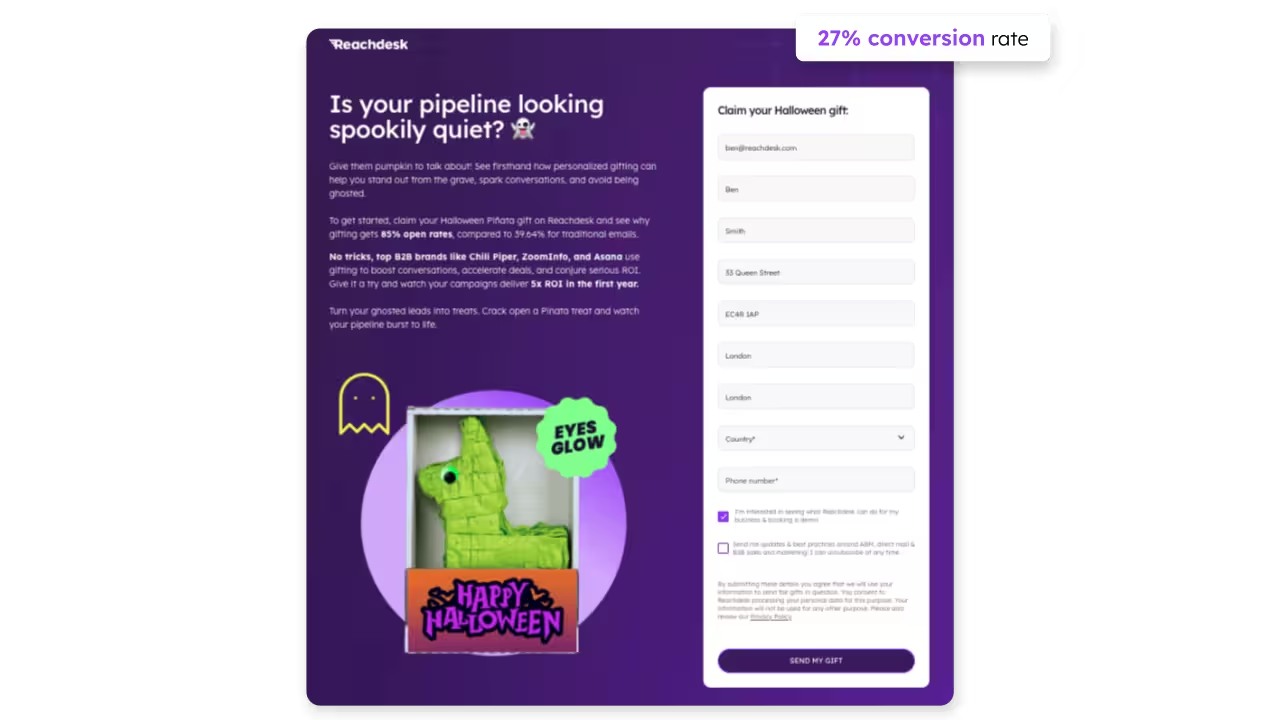
Seasonal gifts add a unique touch to nurture campaigns, re-engage quiet contacts, and spark fresh conversations. Plan for $30 to $70 per gift.
Trade show follow-up email templates
People you met. Send within 48 hours, while they still remember you.
"Hi [Name]. Good to actually meet at [Event]. You said [thing they said], which stuck with me. Sending the thing I promised. Worth 30 minutes to carry it on now we're both back at a desk?"
People you missed. Use it for the list you scanned but never spoke to.
"Hi [Name]. We didn't manage to catch you at [Event], which is on us. Here's the one thing worth taking from it, plus a gift for missing you. If [topic] is live for you this quarter, I'd like 20 minutes."
Notice what both emails do. They reference something specific, and they send the gift with a reason. That specificity is what makes a follow-up feel personal instead of automated.
How to tier your trade show swag and budget for ROI
Not every attendee deserves the same gift, and that's not a bad thing. Tiering lets you spend where the pipeline is and still give everyone else a good experience.
Our rule is simple. Named Tier 1 and Tier 2 accounts get a premium item, booked in advance and handed over in person. Everyone else gets access to a store portal they unlock through a real conversation. As we put it internally: qualify harder at the booth, not louder.
Here's how the plays in this guide stack up, with the giveaway we used for each and the cost per gift.
Let ACV and opportunity value set the ceiling. A $200 gift is cheap if it opens a six-figure deal and wasteful if it goes to someone outside your ICP. Decide your tiers before you build the invite list, and trade show ROI becomes something you can actually measure, because every send is tied to an account and a meeting.
5 trade show giveaway mistakes to avoid
Even a great swag plan can fall flat on the day. These are the traps we see most often, including a few we've walked into ourselves.
1. Forgetting where the event actually is
We once ordered clack fans for an event in Phoenix. Perfect for desert heat. Then it rained. Before you lock in an item, check the venue, the season, and the forecast, and ask whether people will actually use it there.
2. Chasing trends you can't deliver fast
Viral collectibles and the latest must-have item can make a booth feel current. But trends move faster than most production timelines. Unless you can source, brand, and ship at lightning speed, you'll show up with last month's moment.
3. Building a queue instead of a conversation
A live customization station sounds fun until the line hits 45 minutes. Decision-makers won't wait in it, and the people who will are rarely your buyers. If an activation creates a long queue, it's attracting volume, not quality.
4. Defaulting to mugs and pens
There's nothing wrong with a good mug. There's a lot wrong with a booth that offers nothing else. Generic trade show giveaways blend into the noise. Unique trade show giveaways tied to a campaign story give people something to talk about.
5. Leaning on the logo instead of the story
A giant logo doesn't make an item memorable. Emotional resonance does. Lightly branded swag, like our "From URL to IRL" denim jacket, invites curiosity, and people remember you every time they wear it and someone asks about it. Let the theme do the work and keep the branding subtle.
The common thread: event swag works best when it's tied to your go-to-market motion, not treated like consumer merchandise. Intentionality and storytelling are what separate pipeline from clutter.
Make your next event swag count
The events that drive the most pipeline aren't the ones with the biggest booth or the longest giveaway table. They're the ones where every gift has a job: fill the seat, earn the conversation, extend the memory. Plan your swag across all three stages, tier it by account value, and tie every send back to a meeting.
Reachdesk is the revenue enablement platform behind every play in this guide. Marketing, sales, and events teams use it to run pre-event offers, room drops, swag stores, and post-event follow-up in one place, with every send tracked back to pipeline in your CRM. Book a demo to plan your next event's gifting with our team.
Event swag FAQs
What is an event swag strategy?
An event swag strategy is a plan for using gifts and branded items before, during, and after a trade show or conference to hit specific goals, like meetings booked and pipeline created. Instead of ordering items for the booth table, you assign each gift a job at a specific stage of the event.
What are the best trade show giveaways?
The best trade show giveaways are tied to a campaign story and offered in exchange for a meeting or a real conversation. A hero item, like a custom jacket or a premium camera kit for target accounts, outperforms a pile of generic pens because people have to earn it and want to talk about it.
How many giveaways should you bring to a trade show?
Start with your target account list, not the expected footfall. Order premium items for named Tier 1 and Tier 2 accounts, then use a swag store portal for everyone else so you only ship items to people you've actually spoken to. You'll waste less and qualify more.
How much should you spend on event swag per person?
It depends on the play and the account. Our recommended ranges run from $10 to $50 for brand moment activations up to $200 for pre-booked meetings and room drops with high-value accounts. Let ACV and opportunity value set the ceiling.
How do you measure the ROI of trade show giveaways?
Tie every send to an account and a meeting before the event. Then track meetings booked, pipeline created from those meetings, and revenue from the deals they influence. Divide your total gift and shipping spend by meetings booked to get a cost per meeting you can benchmark against your other meeting sources. Connect your gifting platform to your CRM so gift influence shows up in your pipeline reports without manual tracking.
How do you use swag to book meetings before an event?
Build a gifting landing page that offers a desirable gift in exchange for a booked meeting, then promote it by email two to three weeks before the show. Add a booking link so prospects can grab a slot instantly, and give an alternative, like a gift voucher, so the offer appeals to everyone.
How do you follow up after a trade show?
Send a personal follow-up within 48 hours that references something specific from your conversation. Pair it with a gift sent to their home, and add a seasonal nurture touch for contacts who aren't ready to talk yet. Create a separate follow-up for people you scanned but never spoke to.