
Your pipeline target went up. Your reply rates went down.
Your SDRs are sending more emails than ever. Your sequences are longer. Your tools are smarter.
So why is pipeline getting harder to build?
Because your buyers are drowning. Every vendor now has the same AI writing tools, the same data providers and the same 12-step cadence. The result is an inbox full of messages that all sound alike, and a buyer who has learned to ignore every one of them.
The answer isn't to send more. It's to stand out. A pipeline generation strategy that works when cold outbound stalls focuses on accounts showing buying signals, reaches several people on the buying committee, mixes digital and physical touches, and tracks every touch in your CRM. This guide covers what's changed, a six-step plan you can run next quarter, a sample cadence, the metrics to track, and results from B2B teams already doing it.
Why outbound is broken
Outbound isn't dead. But the playbook most teams still run was built for a different inbox. Here's what's changed.
- Volume stopped working. When sending was hard, more sends meant more meetings. Now anyone can send thousands of emails a day. Buyers have tuned out, and spam filters have tightened.
- AI made everything sound the same. Personalization used to mean mentioning a podcast or a recent post. Now every tool does that automatically. When everyone personalizes, nobody stands out.
- Buying committees got bigger. You're not selling to one person anymore. You need to reach finance, IT, the end user and the exec sponsor. A single-threaded email sequence can't do that.
- Buyers research alone. Most of the buying journey now happens before a prospect ever talks to sales. By the time they reply, they've already built a shortlist. If you weren't on their radar early, you're not on it at all.
- Phones don't get answered. Cold calls still work for some teams, but connect rates keep falling. Remote work means desk phones ring in empty offices.
None of this means you should stop prospecting. It means you need to earn attention instead of demanding it.
What pipeline generation looks like now
Pipeline generation is everything your team does to create qualified sales opportunities. That includes outbound prospecting, inbound demand, events, partners and account-based marketing.
Teams that keep building pipeline while cold outbound stalls tend to share three habits.
1. They go where the signal is
Instead of blasting a static list, they prioritize accounts showing real buying signals. Think a new exec hire, a funding round, a website visit or a job post that hints at your use case. A smaller list with real intent beats a huge list with none.
2. They use more than one channel
Email is one touch, not the whole plan. Strong cadences mix email, LinkedIn, phone, video and physical touches like direct mail and gifts. Each channel gives the buyer another way to notice you, and another way to reply.
3. They make outreach feel human
A relevant gift on someone's desk is hard to ignore. It shows you understand their role and gives your rep a real reason to follow up. That's why more sales and marketing teams are adding gifting and direct mail to their outbound cadences, and tracking each send against meetings and pipeline. It cuts through in a way a seventh follow-up email won't.
The common thread? Fewer, better touches aimed at the right people at the right moment.
A pipeline generation strategy in 6 steps
To build a successful pipeline generation strategy, start with your revenue goals, identify high-fit accounts, engage the right decision-makers, and use personalized, multi-channel outreach to turn interest into qualified opportunities. The key is aligning sales and marketing around the same targets, tracking what drives pipeline, and continuously optimizing your approach. Follow these six steps to build a predictable pipeline that converts into revenue.
- Work back from your number. Start with your revenue target and your win rate. If you need $2M in new revenue and you win 25% of deals, you need $8M in qualified pipeline. Now you know what you're building toward.
- Tighten your ICP and target list. Define the accounts and roles most likely to buy. Then score them on fit and intent. Focus your best effort on the top tier, and let automation handle the rest.
- Map the buying committee. For each top-tier account, list the three to five people who influence the decision. Plan touches for each of them, not just your main contact.
- Build a multi-channel cadence. Mix email, LinkedIn, phone and at least one physical touch. Place your gift or direct mail where it does the most work: early to open the door, or mid-sequence to revive a quiet thread.
- Make every touch relevant. Tie your message and your gift to the prospect's world. A book on their exact challenge beats a generic swag pack every time. Relevance is what turns a nice gesture into a meeting.
- Track and tune weekly. Log every touch in your CRM. Review meetings booked, pipeline created and response rates by channel each week. Double down on what works and cut what doesn't.
A sample multi-channel outbound cadence
Not sure where a gift fits? Here's a simple three-week cadence for a top-tier account. Use it as a starting point, then adjust the timing to your sales cycle.
| Day | Channel | Touch |
|---|---|---|
| 1 | Connect with a short, relevant note. No pitch. | |
| 2 | Share one insight tied to a signal you spotted, like a new hire or product launch. | |
| 4 | Phone | Quick call to follow up on the email. Leave a 20-second voicemail. |
| 6 | Gift | Send a personalized gift tied to their role or challenge, with a handwritten note. |
| 8 | Follow up on the gift and suggest a 20-minute call. | |
| 10 | Engage with their content or send a short video message. | |
| 14 | Phone and email | Reach a second person on the buying committee with a tailored angle. |
| 21 | Close the loop. Offer a useful resource and leave the door open. |
A few tips to get the most from this cadence:
- Time the follow-up to the delivery. Your email on day 8 should land just after the gift arrives, not before.
- Let prospects choose. Gift options or eGifts help when you don't know someone's taste, or when they work from home.
- Multi-thread early. If your main contact goes quiet, the second thread on day 14 keeps the account warm.
Want more plays like this? Browse the Gifting Cadence Library for ready-made sequences you can adapt for SDRs, AEs, and ABM programs.
How B2B companies use gifting to generate pipeline
Here's how two B2B teams used gifting and direct mail to build pipeline when email alone wasn't enough.
SentinelOne: $1.1M in pipeline from creative gifting
SentinelOne's ABM team wanted to open conversations with target accounts the company hadn't reached before, from C-level executives to practitioners. Until then, most of its gifting had been one-off BDR sends that weren't personalized or tied to a measurable campaign. So the team built curated campaigns around SentinelOne's partnership with Aston Martin and Formula One.
- First campaign: A LEGO set modeled on an Aston Martin, sent with a custom sticker set and a booklet of customer case studies.
- Holiday campaign: A landing page that invited target accounts to claim a remote-controlled Aston Martin car. Stock was nearly gone within a day of launch.
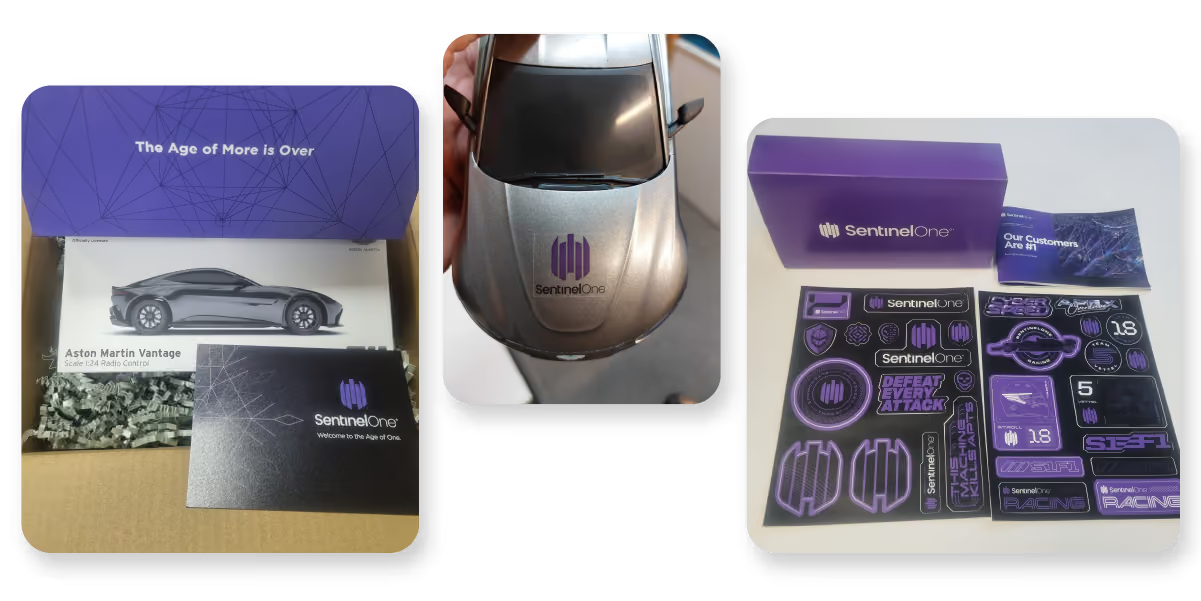
The team used Reachdesk's Salesforce integration to track campaign data and its Marketo integration to build campaign landing pages. Across its gifting and direct mail campaigns, SentinelOne has generated $1.1M in pipeline and a 38.7x ROI, with a 44% redemption rate.

Iterable: 350 pipeline opportunities influenced
Iterable built gifting into its ABM and field marketing programs and scaled it fast. For one AI product launch, the team sent custom bundles with Iterable-branded fortune cookies and magic 8-balls with marketing slogans inside. It was a playful way to show off the product's predictive features.
| Metric | Result |
|---|---|
| Pipeline opportunities influenced since 2021 | 350 |
| Closed-won deals influenced in 2024 | 91 |
| Gifts sent | 12K+ |
| Increase in gifting activity | 6x |
| Engagement from executive sponsors | 49% |

Verkada: gifting became its #1 cold outbound channel in EMEA
Verkada's EMEA team relied on email for outbound. But once you'd emailed someone, the only option was to email them again. Senior Growth Manager Bayo Bankole rebuilt the gifting program around three changes:
- A gift worth keeping: Verkada-branded building blocks that build a miniature monitoring station or access control gate replaced brownies. That switch alone lifted ROI by 40%.
- Tighter targeting: The team prioritized schools, then manufacturing, and tailored each gift note to the recipient's industry.
- Automated sends: A Clay workflow connected to Reachdesk handles lead scoring, address verification, and sends. Every send flows into Salesforce. Delivery accuracy rose from 60-70% to 95%.
Gifting overtook email as Verkada's #1 cold outbound channel in EMEA, and annual sends grew more than 10x.

The lesson from both? A creative, relevant physical touch gets the attention your emails can't, and tracking it in your CRM proves what it's worth.
7 key pipeline generation metrics and how to measure them
To measure pipeline generation performance, track seven key metrics: pipeline created, pipeline coverage, meetings booked, response rates, meeting-to-opportunity conversion, pipeline velocity, and cost per opportunity. Together, these KPIs show how effectively your sales and marketing efforts generate qualified opportunities, move deals forward, and contribute to revenue. Here's what each metric tells you and how to calculate it.
| Metric | What it tells you | How to calculate it |
|---|---|---|
| Pipeline created | How much new opportunity value you're adding | Total value of new qualified opportunities in a period |
| Pipeline coverage | Whether you have enough pipeline to hit target | Open pipeline divided by revenue target |
| Meetings booked | Whether outreach is turning into conversations | Count of qualified first meetings held |
| Response rate by channel | Which channels earn attention | Replies divided by touches, per channel |
| Meeting-to-opportunity rate | Whether you're meeting the right people | Opportunities created divided by meetings held |
| Pipeline velocity | How fast pipeline turns into revenue | (Opportunities × deal size × win rate) divided by sales cycle length |
| Cost per opportunity | How efficiently you create pipeline | Total program cost divided by opportunities created |
Most teams aim for pipeline coverage of 3x to 4x their target. If you're well below that, fix volume and targeting first. If coverage looks healthy but you still miss your number, look at velocity and win rate.
5 pipeline generation mistakes to avoid in outbound
Common pipeline generation mistakes include prioritizing outreach volume over qualified opportunities, targeting every account the same way, failing to follow up, poor sales and marketing alignment, and ignoring the CRM data you already have. These mistakes waste budget, slow down deals, and make it harder to hit revenue targets. Avoid these five pitfalls to build a more efficient B2B pipeline generation strategy that delivers measurable results.
- Chasing activity instead of outcomes. A team that sends 10,000 emails and books 5 meetings isn't busy. It's broken. Measure meetings and pipeline, not sends.
- Treating every account the same. Your top 50 accounts deserve a different motion than your next 5,000. Save high-touch plays like personalized gifts for the accounts where a single deal moves your quarter.
- Sending gifts with no follow-up plan. A gift without a next step is just a nice surprise. Have your rep reach out within a day or two of delivery, while the moment is fresh.
- Keeping sales and marketing apart. Pipeline is a shared number. If marketing runs campaigns sales doesn't know about, or sales ignores the accounts marketing is warming up, you lose deals in the gaps.
- Ignoring the data you already have. Your CRM knows which past deals closed fastest and which channels started them. Use that to shape your plan before you spend a dollar on new tools.
Pipeline generation FAQs
What is pipeline generation?
Pipeline generation is the process of creating qualified sales opportunities for your team to work. It covers outbound prospecting, inbound marketing, events, partnerships and account-based programs.
What's the difference between pipeline generation and lead generation?
Lead generation captures interest, like a form fill or an event sign-up. Pipeline generation goes further and turns that interest into qualified sales opportunities with a value attached. A lead becomes pipeline once sales agrees it fits your ICP and there's a real buying need to work.
Who owns pipeline generation?
Both sales and marketing. Marketing usually owns inbound and campaign-sourced pipeline, while SDRs and AEs own outbound. The best teams share one pipeline target and report on it together.
What is a good outbound sales strategy in 2026?
A good outbound strategy is signal-led, multi-channel and multi-threaded. Focus on accounts showing buying intent, reach several people on the buying committee and combine email, LinkedIn, phone and physical touches like gifts.
How much pipeline coverage do you need?
Most B2B teams aim for 3x to 4x pipeline coverage. That means $3 to $4 in open pipeline for every $1 of revenue you need to close. Teams with lower win rates need more.
Does gifting help with pipeline generation?
Yes, when it's targeted and tracked. A relevant gift gets attention in a way email can't, and gives your rep a natural reason to follow up. Tie every send to your CRM so you can see which gifts led to meetings and pipeline.
How do you calculate pipeline velocity?
Multiply your number of qualified opportunities by average deal size and win rate. Then divide by your average sales cycle length in days. The result is how much revenue your pipeline produces per day.
Generate more B2B pipeline with personalized gifting
Outbound isn't going away. But the teams that win from here won't be the ones who send the most. They'll be the ones who show up with the right message, for the right person, at the right time.
Start small. Pick your top 25 accounts. Map the buying committee, build a multi-channel cadence with one meaningful physical touch and track the results for a quarter. Then scale what works.
Want to add gifting and direct mail to your pipeline strategy? See how Reachdesk helps go-to-market teams turn buying signals into meetings, with every send tracked in Salesforce or HubSpot.