
Marketing and sales alignment is an operating model in which marketing, sales, and customer success work from a single target account list, a shared definition of a qualified opportunity, and a single pipeline number, rather than passing leads across a handoff seam. In practice, alignment is measured by shared pipeline contribution, not by meeting cadence.
Although alignment has been a stated goal for well over a decade, that operating model remains surprisingly rare. Nearly every go-to-market leader agrees it matters, yet for most organisations, it still exists as an aspiration on a strategy slide rather than shaping how teams operate day to day.
The numbers make the gap impossible to ignore. Forrester found that 82% of executives believe their sales and marketing teams already work well together, while 65% of the people actually doing the work say the opposite. That’s not a small disagreement. It’s a perception gap between leadership and frontline GTM teams, and it explains why so many alignment initiatives stall before they start: the people with the authority to fund a fix don't believe there's a problem to fix in the first place.
The stakes make the gap worth closing anyway. Only 8% of companies report strong sales and marketing alignment, yet aligned teams grow revenue 24% faster over three years than their misaligned counterparts. Most organizations know the prize is worth chasing. Very few have actually caught it.
This guide pulls from episode three of The Pattern Break, where we brought together three go-to-market leaders to talk honestly about why alignment is so hard, what shared pipeline ownership actually looks like, and how corporate gifting fits into a genuinely aligned motion. Here's what Jen Barry, Director of Integrated Marketing at DISCO, Katie Penner, VP of Sales Development at Influ2, and Melissa Coleman, former VP of Revenue Operations at nShift, had to say.
Why the lead handoff model keeps breaking in GTM
The traditional handoff model made sense in a simpler buying environment: one buyer, a linear funnel, marketing passes a lead, sales closes it. That world no longer exists.
Today, most teams pass along the majority of leads they generate, but only about a quarter turn out to be genuinely qualified. Half of sales leaders don't even agree with marketing on what "qualified" means in the first place. Add in the reality that a typical B2B purchase now involves six to ten stakeholders, not one champion, and it becomes clear why 86% of purchases stall somewhere along the way. Every one of those friction points sits directly on the handoff seam.
Katie Penner pointed to a root cause that goes deeper than process. Teams aren't misaligned because they dislike each other. They're misaligned because they're not working toward the same goals, and multi-touch attribution, which should tie those goals together, is genuinely hard to implement well. Deciding what counts for which team, and how to avoid double-counting while still hitting revenue targets, takes a fundamentally different way of thinking about planning.
Jen Barry offered a reframe worth sitting with: this was never just a sales and marketing problem. It's a go-to-market problem. If sales, marketing, business operations, and customer success aren't pulling in the same direction, the entire revenue motion suffers, regardless of how well any single team performs in isolation. DISCO addressed this directly by building a centralized go-to-market org that supports sales, marketing, and CS under one roof, rather than treating each as a siloed function chasing its own goals.
What good go-to-market alignment actually looks like
Instead of tossing marketing qualified leads over a fence and hoping sales catches them, the panel described a different model entirely: one shared pipeline, one number, and one agreed definition of what qualified actually means.
In aligned organizations, marketing-sourced or marketing-influenced pipeline accounts for 29% of total pipeline. In misaligned organizations, that number drops to just 10%. The difference isn't tooling or budget. It's whether both teams are looking at the same data and rowing in the same direction.
In practice this means a few things.
1. Building pipeline expectations around actual selling motions, not blanket targets
Melissa Coleman described how this works at the revenue operations level. Building a go-to-market budget starts with quota, then works backward into pipeline goals broken down by segment, region, and buyer persona.
A down-market motion should expect a high proportion of marketing-driven demand. An enterprise motion should expect what she calls a "perfect pyramid" of sales, marketing, and partnerships all contributing distinct, expected touches. The point isn't to hit an arbitrary number pulled from a board deck. It's to set expectations that are actually achievable, so that when a deal converts, every team understands exactly what their contribution was.
2. Tying compensation to the behavior you actually want
Jen Barry added a layer that gets skipped constantly: shared ownership only works if compensation reflects it. If SDRs are expected to work marketing-sourced or marketing-influenced leads, they need to be compensated for that work, or it simply won't happen consistently.
3. Keeping the data clean enough to trust
A handoff is only as good as the CRM data behind it. If your systems aren't clean, your SLAs and your reporting will be too, no matter how well-intentioned the alignment strategy is on paper.
Why go-to-market orchestration is replacing automation
A theme that ran through the entire conversation was orchestration: not just automating handoffs, but designing coordinated plays where every team runs off the same signal, in sequence, without dropping context along the way.
In an orchestrated model, marketing warms an account. An SDR reaches out with real context, not a cold template pulled from a sequence tool. Sales works the full buying group rather than chasing a single champion. CS brings continuity into the room once the deal closes. It's the same account, the same story, with no cold restart at any stage.
Katie Penner noted that this trend is accelerating because the tooling has finally caught up. Orchestrating sales, marketing, and customer experience efforts across the full customer journey, and automating the coordination between them, is becoming genuinely achievable rather than aspirational.
One of the clearest practical steps behind this kind of orchestration is a single, unified target account list that sales, marketing, and CS all plan against. Jen Barry described how DISCO grounds this list in its own customer data and broader market data, not opinion. Everyone has a view on who the ideal customer is; forcing that view to be backed by evidence is what makes it usable across teams.
The list isn't static either. It gets revisited constantly. If growth is showing up in accounts that aren't currently on the list, the team asks whether they should be added. If tier-one accounts aren't producing the expected revenue, the team asks hard questions about why, and adjusts the list rather than defending a stale definition. Melissa Coleman builds on this with what she calls a live prospection model, where AI-driven signals continuously flag when accounts should be added or removed, matched against where the company has already won by vertical, segment, and persona. Landing customers teaches you how to grow. Ignoring that data and prospecting blind just repeats avoidable mistakes.
Where corporate gifting fits into an aligned GTM motion
Gifting came up repeatedly, and not as a side channel. Each panelist described it as a tool that only works well when it's genuinely intentional and tied to a real signal, not a calendar-driven campaign or a generic swag drop. Here are three specific plays worth understanding in detail.
Gifting play 1: How DISCO puts gifting directly in the hands of sales reps
.avif)
Jen Barry described how DISCO's field marketing team built a program that treats gifting as a sales-owned tool rather than a marketing-only channel.
The mechanism is simple by design. Reps are trained to listen for moments in live conversations that warrant recognition rather than a pitch: a contact who just wrapped a grueling three-week stretch gets a Starbucks gift card. A contact who shares personal news, like an upcoming baby, gets a branded bundle. A new customer completing onboarding gets a welcome package that reinforces they made the right choice. None of these sends are designed to force a meeting. They exist to say, "I noticed."
The insight behind the program is that gifting works best as a relationship tool sales reps can reach for in the moment, not a centrally planned campaign they wait on marketing to run. By giving reps direct access and clear guidance on when to use it, DISCO turned gifting into one of its highest-performing channels precisely because it stopped looking like a channel and started looking like attentiveness.
Gifting play 2: How Influ2 used direct mail to convert senior-level buyers

Katie Penner's team at Influ2 ran a two-part direct mail campaign built around an Oura ring, paired tightly with contact-level intent data and coordinated marketing air cover.
The structure was deliberate. SDRs identified engaged prospects at target accounts using contact-level intent signals, then nominated the most engaged contacts into a short, three-step outreach sequence. Those prospects were directed to a landing page where they submitted their address and received the first kit: a branded box with a brochure and an Oura ring sizing kit. The brochure included a QR code linking to a short, self-guided product walkthrough designed to feel light and low-pressure rather than a forced demo. Prospects who completed the walkthrough were then offered a calendar link, with no obligation to book at any earlier step. Throughout the sequence, marketing ran contact-level advertising to the same accounts, reinforcing the outreach SDRs were already running.
The result: 60% of senior-level (VP and above) recipients booked a meeting, and the campaign generated 84 times its cost in pipeline. The gift itself wasn't what made it work. It was the alignment between the intent signal, the SDR sequence, and the marketing support behind it, all pointed at the same account at the same time.
Gifting play 3: How nShift uses surgical, moment-based gifting under compliance constraints
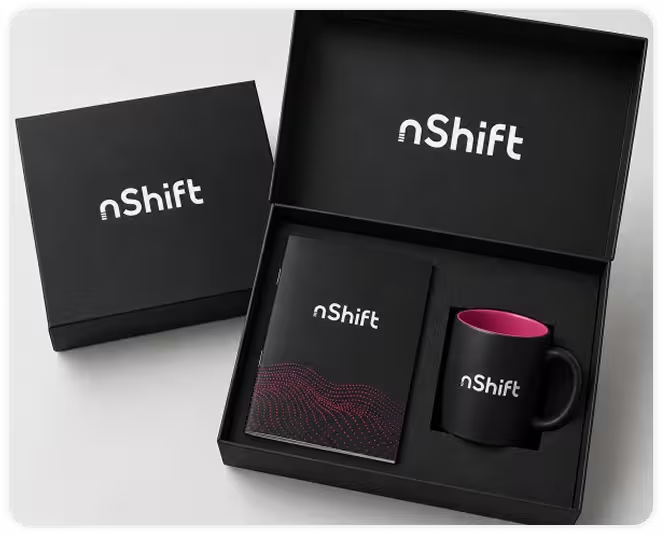
Melissa Coleman's approach reflects a different set of constraints, particularly the stricter gifting and bribery regulations that apply across EMEA. Rather than running broad gifting campaigns, her team uses gifting for specific, high-leverage moments within a deal.
One example: as deals move into later stages, new buying committee members enter the picture, often finance stakeholders whose approval is required to close. To reach them, the team printed ROI-focused booklets making the financial case for the software, paired with a smaller, more generic gift sent directly to that stakeholder. The gift wasn't the focus. It created a reason to open the package and engage with the ROI content at exactly the moment finance needed to be convinced.
Alongside these targeted sends, Melissa is also a fan of guerrilla-style physical touches that create buzz without crossing compliance lines: an ice cream van sent to an office, or a coordinated gesture that gets an entire office talking. These moves work within regulatory limits by staying broad and playful rather than individually valuable, while still creating the kind of physical, memorable moment that digital outreach alone rarely achieves.
Extending gifting to customer success
Across all three plays, one point held consistent: gifting shouldn't sit exclusively with marketing. Marketing should own broader one-to-few campaigns, but CS reps need their own access to a gifting platform, because the most effective gifting is deeply personal. A customer mentions they're going on maternity leave during a call, and a branded onesie arrives days later. That kind of specificity is what makes gifting feel like genuine attention rather than a generic touchpoint, and it's very hard to deliver if gifting sits behind a marketing approval queue.
Why shared pipeline ownership is the key to GTM alignment
Looking across everything the panel described, one principle runs through all of it.
The organizations closing the alignment gap are not the ones with the biggest budgets or the flashiest tech stack. They are the ones who have agreed on one definition of qualified, one shared pipeline goal, and one target account list, and who use tools like gifting with intention rather than as a volume play.
That requires treating go-to-market alignment as an operating motion you build deliberately, not a value you state in a handbook. It requires compensation structures that reward the behavior you actually want, data clean enough to trust, and coordinated plays where marketing, sales, and CS all work from the same signal instead of dropping context at every handoff.
Once teams are aligned internally, the next challenge becomes engagement: creating experiences that actually resonate with enterprise buyers who are harder to reach than ever. That's a conversation worth having on its own.
Want to see what alignment looks like in practice?
The full Pattern Break series brings together senior go-to-market leaders to unpack what's genuinely working in B2B right now, from buyer engagement and outreach strategy to internal alignment and orchestration. You can watch Episode 3 here or explore the rest of the series now.
Reachdesk is the revenue enablement platform behind plays like these. We give sales, marketing, and customer success a shared system for triggering gifts, direct mail, and experiences off the same signals, with every send tracked back to the pipeline, so shared ownership shows up in reporting rather than only in the operating agreement. You can see how it works by booking a demo with our team here.
Common marketing and sales alignment FAQs:
Why is marketing and sales alignment still a problem in 2026?
The gap is largely perceptual. Executives tend to believe alignment already exists, while the teams doing the day-to-day work report otherwise. Without a shared definition of a qualified lead and a shared pipeline goal, the friction shows up at every handoff point.
What does good marketing and sales alignment look like in practice?
Aligned teams work from one target account list, one agreed definition of qualified, and one shared pipeline number, with compensation structures that reward marketing-influenced and marketing-sourced wins across every team involved, including customer success.
How does corporate gifting support sales and marketing alignment?
Gifting works best as a coordinated signal-based play rather than a standalone campaign. When SDRs, marketing, and customer success share the same intent data and account context, gifting becomes a genuine relationship-building tool instead of a generic outreach tactic.
What is the difference between sales and marketing alignment and go-to-market alignment?
Sales and marketing alignment addresses two functions. GTM alignment extends the same shared pipeline model across sales, marketing, revenue operations, and customer success, which is where most misalignment actually originates, since deals stall at seams no two-function fix can reach.
Who should own the shared pipeline number?
Shared ownership works when no single function owns it alone. Aligned organizations set the number at the revenue-operations level, break it down by segment, region, and persona, and compensate every contributing team, including SDRs working on marketing-influenced accounts, against it.