
Sourcing swag inventory without overordering comes down to four practices: forecasting demand before placing a bulk order, matching your fulfillment model (bulk vs. on-demand) to each item's actual popularity, right-sizing quantities per size rather than ordering evenly across a size run, and tracking what's already in stock before reordering. Most swag budget waste doesn't come from paying too much per item. It comes from ordering the wrong quantity of the right item, then storing, writing off, or discarding what's left. This guide covers why overordering happens, what it costs, and the concrete steps to source swag that actually gets used.
What causes swag inventory overordering and budget waste?
Overordering usually happens because bulk pricing rewards guessing high, and guessing wrong is invisible until the invoice or the warehouse bill arrives. Ordering more units brings the per-unit price down, so teams round up "just in case" rather than risk a stockout, and that habit compounds every time a new event or hiring wave prompts another bulk order without checking what's already on the shelf.
Corporate buyers are increasingly aware of the problem: in Custom Ink's 2026 Swag Trends Survey of more than 1,000 corporate buyers, 67% said they only consider a swag investment successful if recipients voluntarily wear or use the item, while nearly half reported that seeing discarded promotional products motivated them to rethink their purchasing approach entirely.
A few specific patterns drive most overordering:
- Ordering a full, evenly distributed size run instead of matching quantities to actual size demand
- Placing a new bulk order without checking existing inventory levels first
- Overestimating attendance or headcount growth and ordering to the optimistic number instead of a realistic one
- Treating bulk discounts as savings without accounting for the cost of unsold inventory sitting in storage
How much does overordering actually cost?
Overordering costs more than the wasted units themselves, since unsold inventory also carries storage costs, write-off costs, and eventually disposal costs before a program can recover. Swagopoly, a swag management vendor, estimates that companies waste between 20% and 30% of their promotional merchandise budget annually on inventory that goes unused, which for a company spending $75,000 a year on swag would mean roughly $15,000 to $22,500 lost to inefficiency, according to Swagopoly's 2026 cost control guide. Treat this as a vendor-reported estimate rather than independent research, since a precise, neutral industry-wide figure for swag-specific waste doesn't appear to exist publicly, though the same 20-to-30% range shows up repeatedly across other swag industry sources describing dead stock rates.
Beyond the direct cost, unused swag creates a brand problem too. Discarded or unclaimed branded merchandise sends the opposite signal it was meant to send, and it's increasingly visible to the employees and customers who see it happen.
What's the difference between bulk sourcing and on-demand sourcing?
Bulk sourcing means purchasing a large quantity of an item up front and storing it until it's needed, while on-demand sourcing means purchasing each item only after someone actually orders it, so nothing gets made without a confirmed recipient. Bulk sourcing brings the per-unit price down and guarantees stock is ready to ship immediately, which matters for time-sensitive needs like onboarding kits or event giveaways. On-demand sourcing costs more per unit but eliminates forecasting risk entirely, since every item produced has already been claimed.
The right choice depends on the item, not a blanket policy:
- Use bulk sourcing for: high-frequency, predictable items like onboarding kits and event swag, or a standard logo tee in common sizes, where reorder volume justifies holding stock
- Use on-demand sourcing for: lower-volume items, highly personalized items, or anything with wide size variation, where forecasting is genuinely difficult
- Use a hybrid approach for: programs with both a stable core catalog and rotating or seasonal items, keeping bulk stock only where demand is proven
How do you forecast demand before placing a bulk swag order?
Forecasting demand accurately means basing quantities on actual historical redemption or attendance data rather than optimistic projections, and building in a smaller buffer than instinct suggests. For event swag specifically, PPAI industry benchmarks suggest that roughly 20% of trade show attendees decline a physical item when offered one, which means ordering for about 80% of expected booth traffic, rather than 100%, is a more realistic baseline, as reported in KP Innovations' guide to managing leftover conference swag.
Practical forecasting steps:
- Pull redemption data from the last comparable event or program cycle rather than estimating from scratch
- Apply a realistic decline or non-redemption rate to attendance or headcount projections instead of ordering to the full number
- Separate your forecast for onboarding or always-on items, which follow predictable headcount data, from event items, which depend on attendance that's harder to predict precisely
Steps to source swag inventory without overordering
Sourcing swag without overordering is a sequence of decisions made before a purchase order goes out, not a single quantity guess. The five steps below cover what to work through for each order.
- Check current inventory before ordering anything new. Confirm what's already in stock, including sizes and quantities, before placing a reorder for the same item.
- Forecast demand from historical data, not optimism. Use actual redemption or attendance numbers from a comparable past event or period, applying a realistic decline rate rather than ordering to the full projected headcount.
- Match each item to bulk or on-demand sourcing based on its actual demand pattern. Reserve bulk orders for high-frequency, predictable items and route lower-volume or highly personalized items to on-demand production.
- Order sizes proportionally, not evenly. Use actual size-distribution data from past orders rather than splitting quantities evenly across a standard size run.
- Set a review point before the next reorder. Check sell-through or redemption rate against the original forecast before placing the next bulk order, so each cycle corrects the last one's forecast rather than repeating it.
How do you handle swag sizing without overstocking specific sizes?
Sizing is one of the most common sources of overordering, because most companies size promotional apparel using a symmetric distribution that doesn't match how employee or customer sizing actually breaks down. An even split across small, medium, large, and extra-large routinely leaves a company overstocked in the sizes least requested and out of stock in the sizes most requested.
Two approaches solve this more reliably than an even split:
- Use actual size data from past orders if you have it, and adjust future orders to match the real distribution rather than a generic assumption
- Move sizing to an on-demand or store-based model, where the recipient selects their own size at the point of order, which eliminates size forecasting entirely since nothing is produced until a specific size is requested
What should you do with existing dead stock?
Existing dead stock, meaning inventory with no confirmed recipient and no active plan to distribute it, should be assessed and cleared on a set schedule rather than left to accumulate indefinitely, since it continues to cost storage space and eventually write-off value the longer it sits. Rather than treating this as a one-time cleanup, building it into your sourcing process going forward means it stops recurring.
A practical approach to existing dead stock:
- Audit current inventory by item and size to identify what's genuinely unlikely to be claimed within a reasonable window
- Repurpose usable dead stock as internal employee perks or one-off gifts rather than letting it sit unused
- Route unrecoverable or outdated items to a textile or materials recycling program instead of standard disposal
- Use what you learn from the audit to correct the next order's forecast, so the same items don't get overordered again
What does a well-sourced swag program actually look like?
A well-sourced program has a small, predictable core catalog held in bulk stock, everything else routed to on-demand production, and a regular review point where sell-through data corrects the next order rather than repeating the same forecast. The signal it's working isn't zero leftover inventory. It's inventory levels that stay proportional to actual redemption, and a forecast that gets more accurate each cycle instead of staying flat.
Common mistakes when sourcing swag inventory
Most overordering mistakes happen at the forecasting and sizing stage, not because a vendor overcharged or a design went wrong. Ordering to a round number instead of actual data, applying the same sourcing model to every item regardless of demand, and skipping an inventory check before reordering are what turn a reasonable swag budget into recurring waste.
Watch for these before they become a pattern:
- Ordering a round number ("let's just get 500") instead of a number based on actual forecasted demand
- Applying bulk sourcing to every item regardless of how predictable its demand actually is
- Splitting size runs evenly instead of using real size-distribution data
- Reordering without checking existing inventory first
- Treating dead stock as a one-time cleanup instead of feeding it back into future forecasting
How Reachdesk helps you source swag without overordering
Reachdesk, B2B gifting and swag ordering platform, combines Swag Sourcing, Merchandise Builder, and Store Portals, so companies can choose bulk or on-demand production per item, and let employees select their own size at checkout, rather than defaulting to bulk sourcing and guesswork sizing across an entire catalog.
1. Swag Sourcing in bulk
Reachdesk's Swag Sourcing service runs through a defined sequence for bulk orders: a consultation to understand goals and budget, supplier selection from Reachdesk's sourcing network, design and branding approval, and production with quality checks, followed by a choice to warehouse the finished items for ongoing distribution or ship them directly to a single event (Reachdesk platform data, 2026). This is the right path for high-frequency, predictable items where bulk pricing and hands-on sourcing support are worth the lead time.
2. Merchandise Builder for on-demand orders
For items that don't need a full sourcing consultation, Reachdesk's Merchandise Builder is a self-service tool built directly into the platform, with no setup fees and no minimum order quantity (Reachdesk platform data, 2026). Teams browse a catalog of clothing, bags, tech accessories, and office items, apply their own branding through an online design editor, and place an order without waiting on a supplier consultation. This is the actual on-demand lever for lower-volume or highly personalized items: nothing is produced until an order is placed, and previously designed items can be restocked or reordered directly from the same tool.
3. Store Portals for size-accurate, on-demand ordering
Reachdesk's Store Portals directly address the sizing problem covered earlier in this guide. Because employees or customers can use this to select their own size and item at the point of order, nothing has to be forecast or produced ahead of demand for store-based items, which removes the size-run guessing that causes most apparel overstock.
Together, these three tools cover every overordering scenario in this guide. Swag Sourcing handles the bulk, predictable side of a program. Merchandise Builder handles anything lower-volume or one-off, with no minimums to worry about. And Store Portals removes size forecasting entirely, since employees choose their own size when they order. See Reachdesk's guide to branded swag storefronts for more on how Store Portals work day to day.
A blended approach to Swag Sourcing by Planet DDS
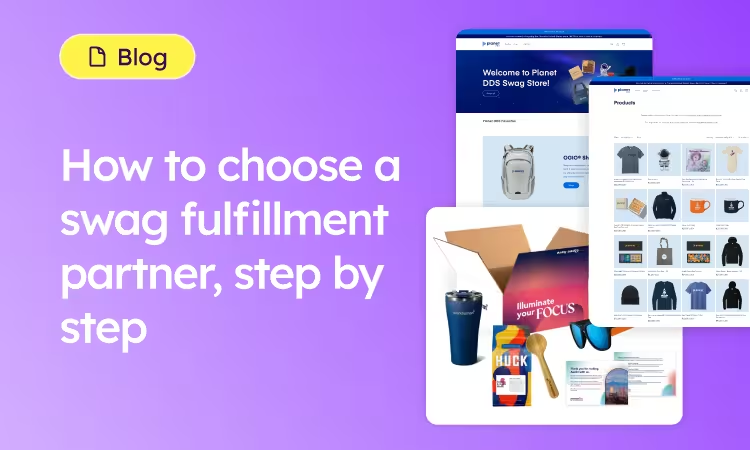
Reachdesk's customer Planet DDS previously pre-purchased swag in bulk, paid per pallet for warehouse storage, and guessed at sizing, which left tenured employees receiving the same branded items year after year while gift cards went unused (Reachdesk customer data, 2026). Moving to Reachdesk eliminated the bulk guessing and storage fees: on-demand fulfillment through Reachdesk's supplier network let the team send items without pre-purchasing anything, while a Store Portal let employees and customers choose their own items instead of drawing down fixed stock. Longer shelf-life items that still made sense to hold in volume moved to Reachdesk's warehouse network, replacing the company's own storage unit entirely. The result was higher employee redemption than under the previous vendor, thanks to a broader, more relevant catalog, and a 93% gift claim rate during early-stage rollout (Reachdesk customer data, 2026).
FAQ: Sourcing swag inventory without overordering
Is bulk sourcing always cheaper than on-demand sourcing?
Per unit, yes, bulk pricing is typically lower. But that comparison only holds if every unit ordered gets used. Once storage, write-off, and disposal costs for unused inventory are factored in, on-demand sourcing is often cheaper in practice for lower-volume or hard-to-forecast items, even at a higher per-unit price.
How do I know if an item should be sourced in bulk or on demand?
Look at how predictable and frequent demand for that specific item is. High-frequency, standard items like onboarding kits or a core logo tee are good bulk candidates. Items with wide size variation, low order volume, or heavy personalization are usually better suited to on-demand production.
What should I do with swag I've already overordered?
Audit what's on hand by item and size, repurpose what you reasonably can as internal perks or smaller gifts, and route genuinely unusable stock to a recycling program rather than standard disposal. Then use that data to correct your next order's forecast so it doesn't repeat.
Does moving to a store-based or on-demand ordering model eliminate overordering completely?
It eliminates over-ordering for anything ordered through Store Portals or built through Merchandise Builder, since nothing is produced until someone actually places the order. It doesn't eliminate the need for forecasting on any items you still choose to source in bulk through Swag Sourcing and hold as pre-stocked inventory, such as high-frequency onboarding items.
Ready to source swag that actually gets used?
Whether you're trying to fix a pattern of overordering or setting up a new program from scratch, Reachdesk combines Swag Sourcing, Merchandise Builder, and Store Portals so you can choose bulk or on-demand production item by item, instead of guessing at quantities across your whole catalog.
Book a demo to see how Reachdesk helps marketing, sales, and people teams source swag without the overordering and waste that come from guessing at demand.