
Choosing a fulfillment partner is a sequence of decisions, not a single vendor comparison. Work through these steps before you sign a contract.
1. Map your event calendar.
List every event for the next 12 months with its country, receiving deadline, and expected swag volume. This tells you which regions matter most and where timelines are tightest.
2. Shortlist on coverage.
Remove any candidate without warehousing or fulfillment coverage in the regions that host most of your events.
3. Score candidates against the criteria table.
Use the five criteria above, and ask the questions in the next section to fill any gaps.
4. Get commitments in writing.
Ask for minimum lead times per destination, duty terms, and return process and pricing as part of the contract or service level agreement, not a sales email.
5. Run a pilot shipment to your highest-risk region.
Test the full process, including customs and returns, on the destination with the tightest timeline or most complex rules before you commit your whole calendar.
What does a swag fulfillment partner actually do for global events?
A swag fulfillment partner handles everything that happens to your merchandise after it's made and before it's in an attendee's hands. That typically includes:
- Storage: Holding inventory in one or more regional warehouses, so stock sits close to where your events happen
- Kitting: Assembling items into bundles or event-specific packs
- Event shipping: Sending freight to the show's advance warehouse or venue to meet a scheduled receiving date
- Customs: Preparing documentation and, depending on the contract, paying duties for international shipments
- Returns and restocking: Bringing unused items back into inventory after the event
Some partners also source and produce the swag itself, while others only handle logistics for items you supply. Confirm which model a vendor offers, because it changes how you plan lead times. For one domestic event, you can manage this ad hoc. For a global event calendar, it becomes a dedicated logistics operation.
Why does event swag fulfillment get harder at a global scale?
Fulfillment gets harder globally because every region adds its own customs rules, delivery timelines, and carrier networks, and a single missed requirement in any one of them can hold a shipment at the border past the event date. Domestic shipping usually just needs enough lead time. International shipping adds customs documentation, import duties, and country-specific restrictions on what can even be shipped, on top of the base transit time. Trade shows carry real financial weight, delivering an average of $20.98 in value for every $1 spent, according to research from the Center for Exhibition Industry Research compiled by Wave Connect, which makes it costly when merchandise doesn't arrive.
A few factors compound as event calendars scale globally:
- Warehousing in only one region means every other region pays for cross-border freight, which is slower and pricier than regional shipping
- Customs documentation requirements vary by country, and incomplete or inaccurate paperwork is one of the most common causes of clearance delays
- Multiple events close together on the calendar can leave no buffer if one shipment is delayed, since there's no time to source a replacement
What criteria should you use to evaluate a swag fulfillment partner?
The right criteria to evaluate a fulfillment partner against are warehousing footprint, delivery lead times, customs handling, return logistics, and reporting visibility, since these are the five places international event fulfillment most commonly breaks down. A partner can look strong on one of these and still fail an event if the others aren't equally solid.
Evaluate candidates against each of these directly:
- Warehousing footprint: how many regions have dedicated warehouses, and do they cover the regions your events actually happen in
- Lead time guarantees: what's the stated minimum lead time for an event shipment, and does that include a buffer before the confirmed arrival date
- Customs handling: does the partner manage documentation and duties directly, or does that fall back on your team
- Return logistics: what happens to unused inventory after the event, and is a return process included or a separate cost
- Reporting and inventory visibility: can you see real-time stock levels and shipment status across every event and region from one dashboard
How much lead time should you plan for global event shipments?
Plan global event shipments by working backward from the date your freight must be received, not the date the event opens. Your total lead time is the sum of four parts: production time for any custom items, your fulfillment partner's minimum processing time, transit and customs clearance for the destination country, and a buffer before the receiving deadline.
Start with the receiving deadline, because it's often earlier than you expect. Most trade shows publish an exhibitor manual with fixed dates for shipments to the show's advance warehouse and a separate, narrower window for deliveries direct to the venue. Freight that arrives outside those windows can be refused or charged extra handling fees.
Then work backward:
- Receiving deadline: The latest date the show's advance warehouse or the venue will accept your freight
- Buffer: At least two business days before that deadline, so a single carrier delay doesn't cost you the event
- Transit and customs: Your partner's estimate for the destination country, including clearance time, not just carrier transit
- Partner processing: Your partner's stated minimum lead time for event shipments
- Production: For custom or personalized items, the time needed for design approval and manufacturing before anything can ship
Ask every candidate partner for each of these figures in writing for your specific destinations. Lead times vary by vendor, country, and item type, so a single number quoted in a sales call rarely covers a global calendar.
Steps to choose a swag fulfillment partner for global events
Choosing a fulfillment partner is a sequence of decisions, not a single vendor comparison. The five steps below cover what to work through before signing a contract.
- Map your event calendar against regional coverage. List every country or region your events happen in, then check which of those a candidate partner has warehousing or fulfillment coverage for.
- Request their minimum lead time and buffer recommendation in writing. Verbal assurances about turnaround don't hold up when a shipment is late. Get the actual SLA documented.
- Ask how customs and duties are handled. Confirm whether the partner manages documentation and duty payment directly, or whether that responsibility falls back on your team.
- Run a pilot shipment to your highest-risk region. Before committing your full event calendar, test the partner's process on the region with the tightest timeline or the most complex customs requirements.
- Confirm the return and restock process. Ask what happens to unused inventory after the event, and whether returns are included in pricing or billed separately.
What questions should you ask a swag fulfillment partner before signing?
The right questions to ask before signing surface the gaps a sales conversation won't volunteer on its own, particularly around what happens when something goes wrong rather than when everything goes to plan.
Ask these directly during evaluation:
- What's your guaranteed lead time for an event shipment, and what happens if that guarantee is missed?
- Which countries can you ship event materials to, and which are excluded or require special handling?
- Who handles customs documentation and duty payments, and is that cost included in your quote?
- What's your process if a shipment is delayed and the event date can't move?
- How do returns and restocking work after the event ends?
What hidden costs should you budget for in global event fulfillment?
Hidden costs in global event fulfillment usually come from the logistics around the swag, not the swag itself, and they're commonly underestimated when building an event budget. Shipping and drayage, meaning the local transport of freight from a port or airport to the final venue, are frequently left out of initial budget estimates, according to Exporb's 2026 trade show budget guide, which specifically flags underestimated shipping and drayage costs as a common budgeting mistake.
Costs worth confirming up front:
- Drayage and material handling at the venue, which show contractors usually bill by weight
- Cross-border shipping surcharges for any region without local warehousing
- Customs duties and taxes, which vary by country, item type, and declared value
- Storage fees for inventory held between events
- Kitting or assembly fees for event bundles
- Return shipping fees for unused inventory, if not included in the base contract
- Rush fees for shipments booked inside the partner's standard lead time
Is a single global fulfillment partner always the right choice?
Not necessarily. A single global partner pays off once you're running events across more than one region regularly. If your events are all in one country or happen only once or twice a year, a regional vendor or one-off logistics arrangement is often simpler and cheaper than onboarding a global fulfillment platform. The signal to consolidate on one global partner is the same one that applies to centralizing swag management generally: once coordination across regions becomes the actual bottleneck, not before.
Common mistakes in global event swag fulfillment
Most failures at global events trace back to small planning gaps, not dramatic logistics problems. These are the ones that catch teams even after they've picked a good partner:
- Shipping straight to the venue without checking the exhibitor manual, then finding freight refused because it arrived outside the receiving window
- Describing items vaguely or undervaluing them on the commercial invoice, which can trigger customs holds or penalties
- Sending power banks or other battery-powered swag without dangerous goods documentation
- Booking the event shipment before artwork and samples are approved, so production delays eat into the shipping buffer
- Budgeting for outbound shipping but not for the return of unused stock after the event
How Reachdesk approaches global event swag fulfillment
Reachdesk, a go-to-market gifting platform, operates a global warehousing network across the United States, Canada, the United Kingdom, Europe, and Australia, covering more than 1.1 million square feet of warehouse space and shipping to more than 180 countries (Reachdesk platform data, 2026).
Lead times and event shipment SLAs
Reachdesk's Event Shipments require a minimum of five business days lead time with a two-day delivery window, and Reachdesk recommends scheduling arrival at least 48 hours before an event's start date to build in a buffer (Reachdesk platform data, 2026). Marketplace gift orders shipped from existing stock typically arrive in two to three days, while bulk Swag Sourcing or custom Merchandise Builder orders can take up to three weeks depending on item complexity, approval timelines, and destination (Reachdesk platform data, 2026). Every event shipment includes a pre-paid return label, so unused inventory can be returned to a Reachdesk warehouse rather than left at the venue or shipped back at full cost.
Reachdesk’s swag sourcing and event fulfillment customer examples: Workhuman and Planet DDS
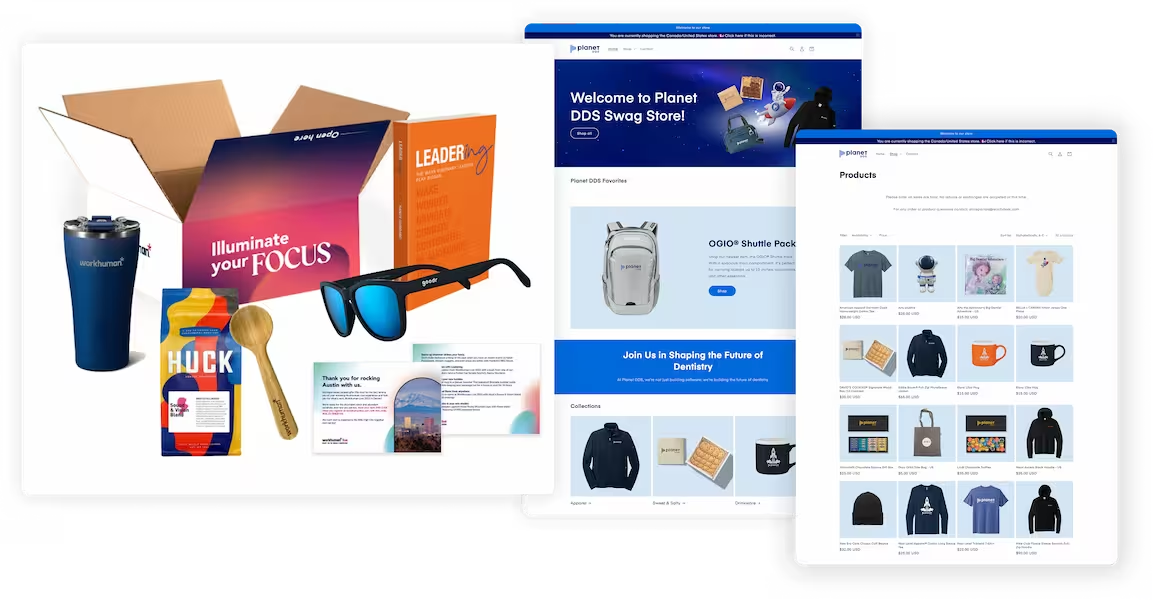
Customers like Workhuman use Reachdesk to source, assemble, and distribute personalized event bundles globally, helping turn 100 bundles into 34 meetings. Whilst Planet DDS replaced manual storage-unit runs and bulk swag management with Reachdesk’s warehousing and fulfillment services. Its first trade show shipment arrived on time, correctly labeled, and with every event-specific detail handled (Reachdesk customer data, 2026).
If your swag program also spans employee ordering or a multi-team budget, this fulfillment layer connects directly to Reachdesk's branded Store Portals and centralized budget controls on the same platform.
FAQ: Choosing a swag fulfillment partner for global events
How far in advance should I book event swag fulfillment?
Work backward from the show's freight receiving deadline, not the event date. Add your partner's minimum processing time, transit and customs time for the destination, and a buffer of at least two business days. Custom or personalized items need production time on top of that, so confirm production and shipping timelines separately.
Do I need separate vendors for different regions?
Not if one partner has warehousing or fulfillment coverage in every region your events happen in. A single partner, like Reachdesk, reduces coordination overhead once you run events in several regions regularly. If your events are mostly in one country, a regional vendor may be simpler and cheaper.
Who's responsible for customs duties on event shipments?
It depends on the contract. Under Delivered Duty Paid (DDP) terms, the shipper covers duties and taxes before delivery. Under Delivered at Place (DAP) terms, the recipient pays them on arrival. Confirm which terms apply, who acts as importer of record, and whether duties are included in your quote.
What happens to unused swag after an event?
That depends on the return process in your contract. Look for a partner, like Reachdesk, that includes return shipping or pre-paid return labels and restocks unused items, so they go back into inventory for your next event instead of being abandoned at the venue.
Ready to simplify your global event fulfillment?
Whether you're running one flagship event or a packed global calendar, Reachdesk gives you regional warehousing, guaranteed lead times, and return logistics in one place.
Book a demo to see how Reachdesk helps marketing and events teams get swag to the right venue, on time, anywhere in the world.