
Comparing corporate swag management software comes down to seven criteria: catalog quality, inventory and storage, integrations with your CRM or HRIS, budget controls and reporting, fulfillment footprint, pricing and total cost, and support. The search often starts after ad hoc ordering has already caused a problem; a missed event deadline, a budget surprise, or a box of merchandise nobody can account for. This guide covers what to evaluate, which questions to ask vendors, and where to find reviews you can trust, so the comparison itself doesn't become another source of delay.
What is corporate swag management software?
Corporate swag management software is a platform that centralizes sourcing, ordering, storage, and shipping of branded merchandise, replacing a mix of spreadsheets, individual vendor relationships, and manual shipping requests. Most platforms in this category fall under a broader "rewards and incentives" or "corporate gifting" software umbrella, since swag ordering, employee recognition, and client gifting frequently overlap in a single platform. Teams use these platforms for different jobs. People teams run onboarding kits and recognition programs, events teams ship booth and attendee merchandise, and marketing and sales teams send branded items to prospects and customers. Which features matter most depends on that job. For employee programs, self-service ordering, team-level budgets, and adoption reporting usually come first.
Why does employee engagement swag need dedicated software instead of a vendor relationship?
A single vendor relationship works for occasional orders, but employee engagement programs run continuously, need budget visibility across teams, and require reporting most one-off vendor accounts don't provide. Employee engagement swag also carries real weight with recipients when done well: nearly two-thirds of consumers say they're very likely to keep a branded product for six months or longer, and almost three-quarters associate branded merchandise with positive emotions such as pride or belonging, according to PPAI's Product Power 2026 study. A vendor relationship can supply the merchandise, but only dedicated software gives an events or people team the budget controls and reporting to run that program at scale without losing track of spend.
What criteria should you use to compare platforms?
Compare corporate swag management platforms on seven criteria: catalog quality, inventory and storage, integrations, budget controls and reporting, fulfillment footprint, pricing and total cost, and support. These map to the points where a swag program most often breaks down after you've signed with a vendor.
Evaluate every platform against each one:
- Catalog quality: Item variety, sizing range, decoration quality, and whether the vendor can tell you how and where items are sourced
- Inventory and storage: Whether you can see live stock levels by item and location, get low-stock alerts, and pre-build kits for onboarding or events
- Integrations: Whether the platform connects natively to your CRM, HRIS, or messaging tools, or whether every order depends on a separate login
- Budget controls and reporting: Whether you can set budgets by team and see redemption and usage data, not just total spend
- Fulfillment footprint: Whether the platform warehouses and ships from the regions where your employees, customers, or events are located
- Pricing and total cost: Whether platform fees, merchandise markups, storage, kitting, shipping, and returns are itemized up front
- Support and service: Whether you get a named contact, help with sourcing and design, and clear turnaround times for urgent orders
How should you weigh integrations and reporting when comparing platforms?
Integrations and reporting matter more than catalog size for most employee engagement programs, because a beautiful catalog nobody can order from through their existing workflow, or spend nobody can report on to finance, undermines the program regardless of item quality. A platform like Reachdesk, that integrates with your HRIS can trigger onboarding kits automatically, while one that connects to Slack or Microsoft Teams makes redemption visible where employees already work.
Specific integration and reporting questions to ask:
- Which CRM, HRIS, or communication tools does the platform natively integrate with, versus requiring a custom build
- Can budgets be set and tracked at the team level, not just company-wide
- Does the platform show redemption rate and repeat usage, or only total orders placed
- Is reporting exportable, or locked inside the platform's own dashboard
Steps to compare corporate swag management software
Comparing platforms works best as a structured process rather than a series of unstructured vendor calls. The steps below move from defining requirements to a final decision.
- Define your must-have criteria before taking vendor calls. Rank catalog, integrations, budget controls, and fulfillment footprint by importance to your specific program before a single demo, so sales conversations don't set your priorities for you.
- Check independent review platforms, not just vendor case studies. Vendor-provided testimonials are curated. Independent review sites like G2 moderate submissions and don't allow paid placement.
- Request a demo focused on your top three criteria only. A generic product tour won't surface whether integrations or reporting meet your specific needs. Ask the vendor to demo exactly those workflows.
- Run a pilot with one team before a full rollout. Test the actual ordering and reporting experience with real users before committing budget and vendor relationships company-wide.
- Confirm pricing structure and hidden fees in writing. Ask specifically about per-item markups, shipping fees, minimum order quantities, and any charges for returns or restocking.
Where should you look for objective, unbiased reviews?
No review source is completely unbiased, so use a combination of independent review platforms, analyst research, customer references, and hands-on product testing. Platforms such as G2 moderate reviews and don’t allow vendors to pay for higher rankings, while firms such as Cloud Ratings combine private customer research with vendor-submitted information. Check that each comparison evaluates the capabilities relevant to your program; such as global fulfillment, integrations, reporting, and support; then validate the findings through customer references and a pilot using your own workflows.
Is dedicated swag management software always necessary?
Not for every team. A single vendor relationship or simple ordering account is often sufficient for a small team ordering occasionally with no need for team-level budgets or cross-region fulfillment. Dedicated software earns its cost once more than one team orders regularly, budget visibility across teams becomes a real requirement, or employees are spread across multiple countries needing local fulfillment.
Common mistakes when comparing swag management platforms
Most comparison processes go wrong before a single vendor is even contacted, not during the vendor evaluation itself. Skipping the requirements step and letting sales demos define your priorities is the single most common way teams end up choosing a platform that doesn't actually fit.
Watch for these mistakes during your evaluation:
- Letting vendor sales calls define your priorities instead of ranking your own criteria first
- Weighing catalog size heavily while treating integrations and reporting as an afterthought
- Relying only on vendor-provided case studies instead of checking independent, moderated review platforms
- Skipping a pilot and committing to a full company-wide rollout based on a demo alone
- Not asking about hidden fees like return shipping, rush charges, or per-item markups until after signing
How Reachdesk compares on these criteria
Reachdesk, a swag sourcing & gifting platform, holds a 4.5 out of 5 rating on G2 across more than 1,223 reviews as of September 2026, with Mid-Market companies making up the largest share of reviewers (G2 data, 2026). On the specific criteria covered in this guide, Reachdesk offers a marketplace of more than 8,500 gift and swag options (Reachdesk platform data, 2026), native integrations with tools including Salesforce, HubSpot, Outreach, HiBob, Workday, and more, and Team Wallets for department-level budget control with real-time reporting.
Swag fulfillment footprint
Reachdesk operates warehousing across the United States, Canada, the United Kingdom, Europe, and Australia, shipping to more than 180 countries (Reachdesk platform data, 2026), which matters directly for the fulfillment footprint criterion covered above.
Reachdesk customer example: How LASSO streamlined employee swag fulfillment
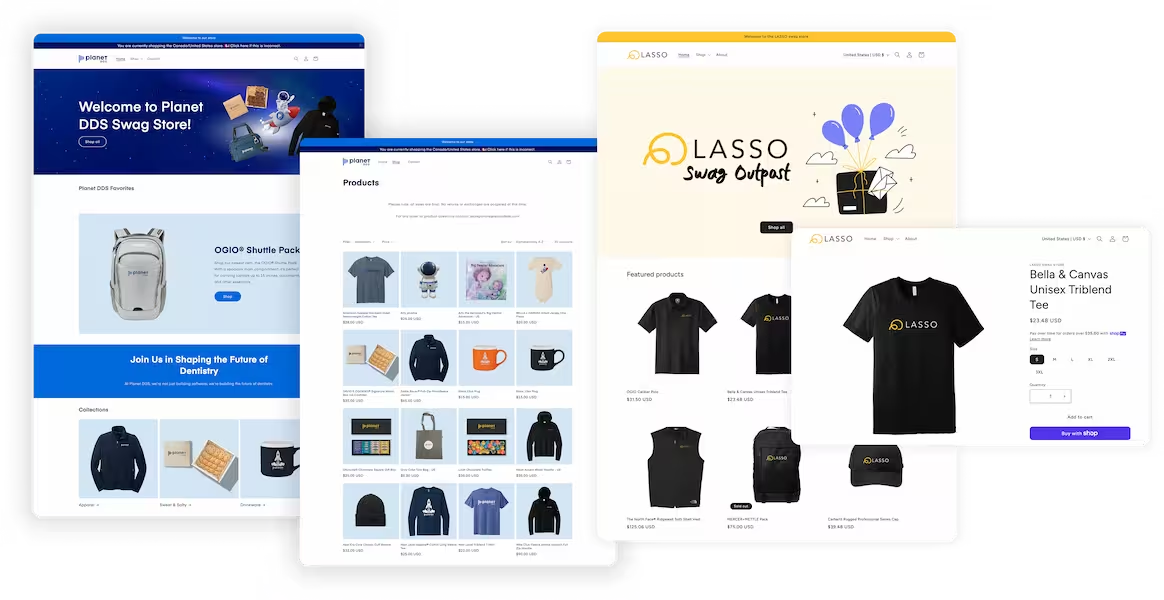
Reachdesk's customer LASSO evaluated Reachdesk specifically against integrations, reporting, and marketplace depth before switching from a previous vendor. One detail that closed the decision: three demo attendees each received a gift that arrived within one to two days, a level of execution speed the team hadn't seen from other platforms during evaluation (Reachdesk customer data, 2026). If your comparison also covers employee self-service ordering or centralizing spend across teams, see the related guides on branded swag storefronts and centralizing swag management.
FAQ: comparing corporate swag management software
What's the most important criterion when comparing swag management software?
There isn't a single most important criterion. The right weighting depends on your program: a distributed team should weigh fulfillment footprint and integrations heavily, while a single-location company might prioritize catalog quality and pricing instead.
What’s the difference between swag management and corporate gifting software?
Swag management software focuses on sourcing, storing, distributing, and tracking branded merchandise. Corporate gifting software typically supports a broader range of physical gifts, eGifts, and personalized campaigns for employees, prospects, and customers. Many platforms like Reachdesk offer both, so compare the specific workflows and features included rather than relying on the category label.
Are G2 ratings a reliable way to compare platforms?
G2 ratings are a useful data point because the platform moderates reviews and doesn't allow paid placement, but a high rating alone doesn't confirm fit for your specific use case. Use ratings alongside a pilot with your own team, not as a replacement for one.
How long should a software comparison process take?
A focused comparison covering three to five vendors, including demos and one pilot, typically takes four to six weeks. Rushing this timeline increases the risk of discovering integration or reporting gaps after a contract is already signed.
Should employee engagement swag and client gifting use the same platform?
Not necessarily, but there's an efficiency case for it if the same team manages both, since a single platform can share catalog infrastructure and reporting across employee and client-facing programs without duplicating vendor relationships.
How much does corporate swag management software cost?
Corporate swag management software costs vary based on platform fees, user numbers, storage, shipping volume, integrations, and service requirements. When comparing quotes, calculate the total cost; including merchandise markups, warehousing, fulfillment, shipping, returns, and rush fees; rather than comparing subscription prices alone.
Ready to compare Reachdesk against your shortlist?
Whatever your must-have criteria are, catalog depth, integrations, budget controls, or global fulfillment, Reachdesk gives you a way to see the platform against your own requirements rather than a generic feature list.
Book a demo to evaluate Reachdesk against your specific comparison criteria for employee engagement swag.