
You have five options for leftover trade show swag: repurpose it for a future event, redistribute it to people who missed the event, donate it, recycle it, or dispose of it as a last resort. The right choice comes down to one question: can the item be reused as it is? Generic, undated items like plain apparel, drinkware, and tech accessories are worth keeping for your next event. Anything printed with an event name or date should leave storage within weeks.
Storage is never free, whether it's a self-storage unit, a fulfillment partner's warehouse, or a corner of your office. So the goal isn't to find somewhere to put leftover swag. It's to give every item a next step and to order less of it next time. This guide covers what causes leftovers, what storing them costs, how to choose between the five options, and how to stop the same surplus building up after your next event.
What causes companies to end up with leftover trade show swag?
Leftover swag is almost always a forecasting problem rather than a storage problem. Teams order for an optimistic trade show attendance projection, order a full size run instead of matching real demand by size, or order extra "just in case" to avoid a mid-show stockout, and whatever doesn't move during the event becomes leftover inventory with no plan attached to it. The swag itself isn't the issue. The absence of a plan for what happens to the surplus is.
A few specific patterns show up repeatedly:
- Ordering to projected attendance instead of a realistic, historically grounded number
- Event-specific branding (a conference name, a year, a specific booth theme) that makes the item hard to reuse at a future event
- No owner assigned to leftover inventory after the event, so it defaults to "wherever there's space" rather than a deliberate destination
- Multiple events close together on the calendar, leaving no time to deal with leftovers from the last one before the next one starts
What does it actually cost to store leftover trade show swag?
Storing leftover swag costs more the longer it sits without a plan, because fees keep accruing whether or not anything leaves the shelf. For a sense of scale, Pure Exhibits' 2026 guide to trade show storage puts a self-storage unit at $50 to $200 a month, or $600 to $2,400 a year. Storing a 10×20 booth at a full-service exhibit house runs $3,000 to $4,800 a year. These figures cover booth and display equipment, not swag specifically.
Public benchmarks for storing swag specifically are hard to find, but the same logic applies. A unit holding nothing but swag pays full rent every month, and every month an item sits there adds to what it really cost you.
What are your options for leftover trade show swag?
Leftover swag has five possible destinations, and the right one depends on how reusable each item is. Work through them in order of value recovered, starting with the option that gets the most use out of what you've already paid for:
- Repurpose it: hold non-dated, non-event-specific items (generic apparel, drinkware, tech accessories) for the next relevant event or as internal perks
- Redistribute it: send dated or event-specific items to people who couldn't attend, turning leftover inventory into a follow-up touchpoint instead of dead stock
- Donate it: route usable items to a charity or community program, particularly for apparel and anything not tied to a specific outdated campaign
- Recycle it: send textiles, branded materials, or e-waste items to a recycling program rather than standard disposal
- Dispose of it: use this only as a last resort for items too damaged, outdated, or low-value to recover anything from
How to redistribute event-branded swag
Event-branded items are hard to reuse at another event, but they still mean something to people connected to the one that just happened. The best recipients for a redistribution send are:
- Registrants who didn't attend, who get a reason to watch the recording or book a follow-up
- Prospects your team met at the booth but ran out of stock for
- Customers who couldn't travel to the event
- Accounts with open opportunities, where a timely package gives sales a natural reason to reach out
Send within a few weeks of the event, while the name still means something, and pair the package with one clear next step, such as the session recording or a meeting link.
How to handle leftover swag after a trade show
Handling leftover swag works best as a five-step process that starts the week the event ends, before boxes get pushed into a storage room and forgotten.
- Audit what's left within a week of the event. Count remaining units by item and size while the event is still fresh, rather than letting it sit in a box until someone asks about it.
- Sort by reusability. Separate generic, non-dated items that can be reused from event-specific items that can't, since this determines which of the five options above applies to each item.
- Assign an owner and a deadline. Give one person responsibility for clearing the leftover inventory within a set window, such as 30 days, so it doesn't become a permanent fixture in a storage room.
- Choose a destination for each category. Route reusable items to storage for the next relevant event, event-specific items to a redistribution campaign, and anything unusable to donation, recycling, or disposal.
- Record what was left over and why. Feed this back into your next order's forecast, so the same item and quantity mistake doesn't repeat at the next event.
How do you prevent ending up with leftover swag at your next event?
Preventing leftover swag starts with forecasting based on actual data instead of optimistic attendance projections, and it continues with choosing sourcing methods that don't require committing to a fixed quantity months in advance. The two biggest levers are ordering to a realistic number rather than a hopeful one, and routing less predictable items through on-demand production instead of a bulk order.
Practical changes that reduce leftover inventory going forward:
- Apply a realistic decline or no-show rate to attendance projections instead of ordering to the full expected number
- Route event-specific or highly personalized items through on-demand production, so nothing is made without a confirmed recipient
- Reserve bulk ordering for generic, reusable items that will still be relevant at a future event if they don't move at this one
When does it make sense to pay for ongoing storage instead of clearing inventory immediately?
Ongoing storage makes sense for items that are genuinely reusable and likely to be needed again soon, not for items sitting in storage simply because no one has decided what to do with them yet. A generic branded tote or a reusable booth backdrop is worth storing until the next relevant event. A conference-dated item from an event two years ago, sitting in the same box the whole time, is a sign the item should have been redistributed, donated, or recycled long ago.
The distinction worth applying before paying for another month of storage:
- Store it if the item has no date or event-specific branding and a next use is already identified
- Don't store it if it's been sitting untouched for more than one full event cycle with no plan attached
Common mistakes when handling leftover trade show swag
Most leftover swag problems come from treating storage as the default decision rather than an active choice made for a specific reason. Putting everything in a storage unit "for now" and revisiting it later is how items end up sitting untouched for years rather than being used, redistributed, or cleared within a reasonable window.
Watch for these before leftover inventory becomes a permanent fixture:
- Storing everything by default instead of sorting reusable items from ones that should be redistributed, donated, or recycled
- Assigning no owner or deadline, so leftover inventory becomes nobody's responsibility
- Repeating the same order quantity at the next event without reviewing what was left over last time
- Paying for storage on event-specific items that will be outdated before the next relevant use comes up
How Reachdesk helps you manage leftover event swag
Reachdesk is a corporate gifting platform for revenue teams that brings warehousing, event logistics, and creative services into one place, so leftover event swag gets a next step instead of an open-ended spot in storage.
Global Warehousing moves leftover inventory into Reachdesk warehouses in the US, Canada, the UK, Ireland, and Australia, which ship to more than 180 countries. Your stock sits in the same real-time inventory platform you use for new orders, with low-stock alerts and exportable reports, so you always know what's left and where it is.
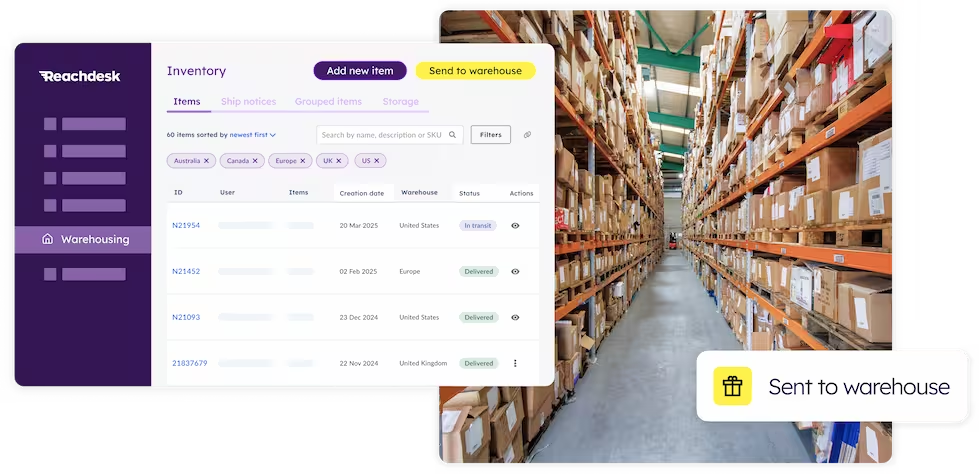
Planet DDS shows how this can simplify event swag management in practice. Before Reachdesk, the team stored leftover swag in a storage unit, paid for space by the pallet, and physically drove there to pack items by hand (Reachdesk customer data, 2026). By moving its bulk swag into Reachdesk's warehouse network, Planet DDS eliminated the separate storage unit and brought existing inventory into the same fulfillment system used for new orders.
Return and redistribute unused event swag
When you schedule an event shipment in Reachdesk, you can opt in to returns and get a pre-paid return label in the box. After the event, pack up whatever's left (no need to count it), attach the label, and drop it off or schedule a FedEx pickup. Reachdesk receives, counts, and stores everything for your next event. Premium Events customers also get a dedicated Events & Logistics Manager for planning, shipping, storage, and fulfillment.
Once that inventory is back in the warehouse, it doesn't have to sit there waiting for the next event. Reachdesk Creative Services can help turn leftover stock into a new gifting campaign, while inventory reporting keeps remaining quantities visible by item.
That's exactly what Planet DDS did after its annual customer summit, Orbit. The team was left with event-specific shirts, pens, lip balm, and bags that could easily have become obsolete inventory. Instead of storing or discarding them, Planet DDS created an "Orbit FOMO" campaign, sending the complete leftover conference package to customers who had missed the event. Reachdesk fulfilled the campaign directly from the warehouse where the swag was already stored (Reachdesk customer data, 2026).

The result is a more circular approach to event swag: return it, keep track of it, and find another opportunity to put it to work, while growing their pipeline, rather than paying to store inventory that may never be used again.
FAQ: Leftover trade show swag
Is it cheaper to store leftover swag or just reorder for the next event?
It depends on the item. Generic, non-dated items are usually cheaper to store and reuse than reorder. Event-specific or heavily personalized items rarely are, since they can't be reused as-is at a different event, which makes redistribution, donation, or recycling the better option over paying to store them indefinitely.
How long should I store leftover trade show swag before doing something else with it?
A reasonable default is one full event cycle, meaning if the item is still sitting unused by the time the next relevant event comes around, it's a sign to redistribute, donate, or recycle it rather than continue paying to store it.
What should I do with leftover swag that has an outdated logo or event date on it?
Event-dated or outdated-branding items are poor candidates for long-term storage, since they can't be reused once outdated. Redistribution to people who missed the original event, donation, or textile recycling are better options than storing something that will never be usable again.
Does consolidating storage with a fulfillment partner actually reduce costs?
It can, mainly by eliminating a separate, uncoordinated storage arrangement and the administrative overhead of managing inventory across two systems rather than one. The savings come from consolidation and better visibility into what's actually in stock, not from storage itself becoming free.
Ready to stop storing event swag with no plan attached?
Whether you're trying to clear out a backlog of leftover event swag or set up a process so it doesn't pile up again, Reachdesk connects sourcing, warehousing, and event fulfillment in one place so leftover inventory always has a next step.
Book a demo to see how Reachdesk helps marketing and events teams manage swag inventory from first order through what happens after the event ends.