

A corporate gifting and swag fulfillment platform is a centralized system for sourcing, storing, shipping, and measuring gifts and branded merchandise across teams, campaigns, and regions. Rather than juggling suppliers, warehouses, spreadsheets, and shipping providers, enterprise organizations use one platform to manage the entire lifecycle while connecting gifting activity to CRM data, campaign performance, and revenue.
For enterprise teams, corporate gifting and event swag fulfillment is a revenue and engagement channel, not a storage problem. The right platform should be judged on six things: inventory governance across teams and regions, CRM and marketing automation integration, reporting tied to pipeline outcomes, approval and budget controls, total cost of ownership, and the reliability of the underlying operating model. A platform that only stores and ships merch is a warehouse with a storefront. One that connects fulfillment to attendance, response rates, and revenue is a pipeline tool.
That distinction matters because event swag carries real weight in the buying journey. A well-timed gift or swag pack gives prospects a reason to register, show up, and take the next step, whether that's booking a meeting, replying to a follow-up, or moving deeper into the buying group. For teams running programs across regions, business units, and event types, the operational load adds up fast: stock visibility, regional fulfillment, returns, and governance all matter when multiple teams draw from the same pool.
The sections below break down what to check in each of those six areas, when it's actually time to make the switch, and the questions to ask any vendor before you sign.
What enterprise features should a swag fulfillment platform have?
An enterprise-ready platform connects fulfillment to your CRM, gives you campaign-level reporting, and enforces governance across teams and regions, not just storage and shipping. Four checks matter most: does it integrate with your CRM and marketing automation stack, does it report on outcomes instead of just inventory counts, does it support approval workflows and budget controls, and does it manage sourcing, quality, and returns without creating extra admin work for your team.
Start with integrations. A platform should connect to your CRM and marketing automation stack so you can track who received what, which accounts engaged, and whether swag influenced attendance, response rates, meetings booked, or downstream conversion. Top event swag solutions like Reachdesk integrate with Salesforce, Marketo, and HubSpot, so gifting activity shows up alongside the rest of your campaign data instead of living in a separate system.
Next, review reporting. Look for campaign-level dashboards, not just inventory counts. You want visibility into event performance, regional activity, and post-send outcomes so marketing ops, demand gen, and sales can compare programs consistently.
Governance matters too. Enterprise buyers should check for approval workflows, role-based permissions, budget controls, and centralized oversight across teams and regions. That keeps field teams moving without creating inventory sprawl or off-brand sends.
Then compare the front-end experience: white-labeled store portals, on-demand merchandise builders, and campaign workflows. These features matter when multiple teams need to launch event packs, client gifts, or employee swag without creating extra admin work.
Finally, ask how the vendor handles supplier selection, quality control, substitutions, and returns. For global programs, this is often where campaigns run into trouble: a delayed shipment, a substituted product, or a return that never gets reconciled. Ask any vendor for a specific answer, not a general assurance.
When your team needs an enterprise-grade gifting and swag platform
You need a dedicated platform once swag management starts costing more in staff time than it would cost to license a system, or once more than one team is drawing from the same inventory without a shared view of stock. Below that threshold, a spreadsheet and a single vendor relationship can work fine. Above it, the manual approach starts creating the exact problems an enterprise platform is built to solve.
A few signals it's time to move your swag program into an enterprise platform:
- Two or more teams (marketing, sales, customer success, HR) are ordering swag independently, with no shared visibility into what's in stock or what's already been committed to an upcoming event
- Your team can't say, without checking multiple spreadsheets or emailing a vendor, how much branded inventory currently sits in a warehouse
- Event swag is sent but not tracked against attendance, response rates, or pipeline, so there's no way to show whether it worked
- Returns from events go untracked, meaning the same items get reordered instead of restocked
- Approvals happen informally, over Slack or email, with no record of who authorized what spend
None of these are failures of effort. They're what happens when a growing swag program outpaces a manual process. A platform doesn't remove the need for good judgment about what to send and when; it removes the operational drag that keeps a good gifting strategy from scaling past one or two teams.
How to manage corporate swag inventory across teams and regions
The fix for swag sprawl is a centralized inventory model with one source of truth for stock, orders, and usage across every team and region. When teams buy and store merch separately, the result is usually duplicated spend, slow fulfillment, stockouts at the worst possible moment, and an inconsistent brand experience from one event to the next.
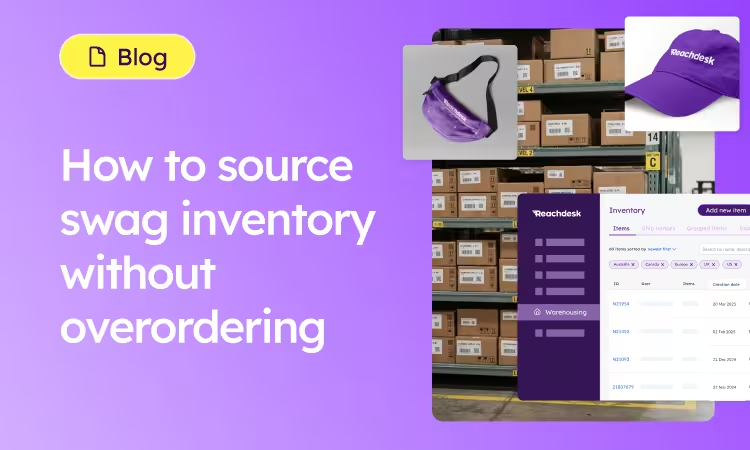
With one system, marketing, sales, customer success, and event teams can all see what's available by region, what's reserved for upcoming programs, and what needs replenishment before a campaign goes live. A practical flow looks like this:
- Pre-event: forecast attendance, reserve stock, and set thresholds for high-volume items
- In-event: track live usage so you don't over-distribute or run out mid-show
- Post-event: process returns, reconcile remaining inventory, and replenish fast-moving items before the next campaign
A field marketing team running a multi-city roadshow needs stock reserved at each stop, live usage tracking so no city runs out mid-event, and post-event reconciliation so leftover inventory rolls into the next stop instead of sitting in a regional office.
Returns handling matters most for regional roadshows and multi-stop programs. As of 2026, Reachdesk's returns process covers the US, Canada, the UK, EMEA, and Australia: every shipment includes a prepaid return label, and leftover items can be dropped off or scheduled for FedEx pickup, with counting and restocking handled on the back end. Reachdesk's event gifting and fulfillment services are built around this shipping, storage, and returns model, and its swag management platform supports sourcing, storing, and shipping across teams from one system in bulk and on demand.
Warehouse location matters too. The closer inventory sits to your audience, the easier it is to hit domestic shipping timelines and avoid last-minute air freight. Reachdesk's global warehouse network, as of 2026, spans the US, UK, EU, Canada, and Australia, with a 5-day domestic shipping service level agreement and 99%+ delivery accuracy rate.
No platform eliminates fulfillment risk entirely. Even strong providers face customs delays, courier disruptions, and demand spikes around major industry events. The real differentiator is how fast a partner communicates and resolves problems, not whether problems ever occur in the first place.
What global fulfillment coverage should a swag solution include?
Global coverage means warehouses and delivery support in the markets where you actually run events, clear shipping service level agreements, and a returns process that works the same way in every region. If you run multi-region programs, your minimum bar should include local or regional warehousing in the areas where you host events and follow up on leads, so stock doesn't cross unnecessary borders before it reaches an event attendee.
Compare warehouse footprint against shipping speed and local delivery options. A broad footprint matters, but so does how quickly stock can move once an event is confirmed. Ask for a clear shipping service level agreement and confirm the vendor can ship directly to the venue before doors open, not just to a regional office. As of 2026, top global platforms like Reachdesk operate warehouses across the US, UK, EU, Canada, and Australia, giving enterprise teams regional fulfillment with a 5-day domestic shipping SLA and 99%+ fulfillment accuracy.
Returns and customs are where many programs get messy. Ask whether the provider includes prepaid return labels, counts and restocks leftovers without requiring your team to itemize, and handles regional logistics reliably after the event. This is one of the most common places where a program's admin cost quietly grows. Solutions like Reachdesk include prepaid return labels in supported regions, with warehouse teams handling inventory reconciliation and restocking to reduce the operational burden after events.
Finally, consider the level of event support that comes with the platform. Global fulfillment is about more than shipping boxes. Ask whether the vendor can support venue deliveries, coordinate event logistics, source merchandise locally, and help manage last-minute changes. Having experienced fulfillment and event specialists alongside the software can make the difference between a smooth event and a stressful one.
Compliance is a filter, not a footnote. Ask any vendor directly for their current ISO certifications and data protection compliance status, and confirm the date, since certifications and audits change over time. Don't assume coverage based on a badge on a website; confirm it against the vendor's current documentation.
Understanding total cost of ownership for corporate gifting and swag platforms
Total cost of ownership includes the subscription or platform fee, the per-gift or per-send cost, and what happens to money committed to gifts that are never redeemed. That last piece is where enterprise buyers most often get surprised, and it's worth understanding before you compare pricing across vendors.
Gifting platforms typically bill in one of two ways: charged on send, where the full gift value is deducted the moment it's sent or an email is opened regardless of whether the recipient claims it, or charged on claim, where the cost is only incurred once the recipient redeems the gift. The second model means unclaimed gifts and eGifts don't consume budget, which matters at scale. A program sending thousands of gifts each quarter can have a meaningful percentage go unclaimed, and a charged-on-send model turns that into sunk cost with no engagement to show for it.
Total cost also extends beyond how gifts are billed. Compare what's included in the platform itself. Some vendors charge separately for warehousing, storage, kitting, packaging, event logistics and warehousing specialist, customer success, creative services, or premium support, while others bundle more of these capabilities into the platform fee. It's also worth checking for minimum order quantities, campaign change fees, or inventory management costs that can increase spend over time.
Reachdesk's pricing model is designed to make gifting spend more predictable. Physical gifts and eGifts are only billed when they're claimed rather than when they're sent, helping reduce wasted budget on unredeemed gifts. Combined with included services such as customer success, event and warehousing specialist, branded packaging, global warehousing, and built-in ROI reporting, that gives buyers a clearer view of the true cost of running gifting and swag programs at scale.
Always ask vendors for a complete breakdown of what's included in the subscription, what's billed separately, and what happens to the value of gifts that are never redeemed.
How to compare corporate gifting and swag platforms
Feature comparison tables rarely tell you which platform will perform best for your business. Instead, compare every vendor against the same evaluation criteria.
Look at native CRM and marketing automation integrations versus manual exports. Compare campaign-level reporting against platforms that only track inventory. Understand whether gifts are billed when they're sent or only when they're claimed. Review warehouse locations against where you actually run events, not simply the number of facilities a vendor operates.
Then compare what's included beyond the software. Implementation, customer success, event logistics, creative services, and warehousing support can all have a significant impact on total cost of ownership. A platform with a larger warehouse network may still cost more overall if key services are billed separately or gifts are charged before recipients redeem them.
The strongest platform isn't the one with the longest feature list. It's the one that best fits your operating model, global footprint, and budget.
8 questions to ask before you sign a corporate gifting and swag platform
How does the platform measure results?
Ask how it tracks attendance, show rates, meetings booked, and post-event conversion, and whether it ties gifting and swag activity to CRM records, campaign IDs, or individual senders. If a vendor can't connect fulfillment data to those outcomes, you'll struggle to prove the program's value later.
How is inventory governed across teams?
Check how stock levels are controlled across departments, regions, and event programs, and whether admins can set approval flows, budget limits, and user permissions. Without this, one team can drain swag inventory meant for another region or launch.
What happens with returns, damage, or replenishment?
Ask for the specific process: how items get returned, how damaged stock is handled, and how replenishment orders are triggered. A vague answer here usually means the process runs on manual follow-up, not a system.
How does the vendor handle global shipping and customs?
Make sure you understand how the vendor manages international shipping, event-site delivery, customs, and regional fulfillment, particularly if you run roadshows or field events. Get specifics on service level agreements, not general reassurance.
How is pricing structured, and what's billed separately?
Find out whether gifts are charged on send or charged on claim, and get a full list of anything billed outside the base platform fee: storage, minimum order quantities, or campaign change fees. This is where total cost of ownership diverges most from the sticker price.
How long does implementation take, and what does onboarding include?
Get a realistic timeline from contract signature to first live campaign, and whether that includes migrating existing inventory, setting up integrations, and training the teams who will use it day to day. A platform that takes a full quarter to stand up carries a real opportunity cost.
What expertise comes with the platform?
The software is only part of the solution. Ask whether creative services, sourcing support, event logistics specialists, implementation, and ongoing customer success are included or charged separately. Enterprise gifting programs are often complex, and access to experienced teams can reduce operational overhead, improve campaign execution, and eliminate the need to hire additional internal resources or external agencies.
Can they show proof, not just promises?
Ask to see real reporting dashboards, CRM and marketing automation integration examples, and the governance controls used by other enterprise accounts. A vendor that can show this in a demo has almost certainly built it for scale already.
A checklist for evaluating swag fulfillment platforms
When evaluating a corporate gifting and swag fulfillment platform, judge it on eight things: sourcing options, CRM and marketing automation fit, reporting, governance, global coverage, returns handling, total cost of ownership, and the operating model behind the platform.
Every part of the operating model should help teams launch programs faster while reducing operational overhead. Most importantly, it should connect every send to measurable business outcomes, giving you clear visibility into what was sent, to whom, when, and the impact it had on engagement, pipeline, and revenue.
Ready to take control of your global swag and gifting programs?
Reachdesk helps enterprise marketing, sales, and events teams manage sourcing, inventory, fulfillment, swag and gifting programs from one platform while connecting every send to pipeline, revenue, and ROI. See how you can reduce operational overhead, improve governance, and create more measurable buying experiences.

.avif)